



• Why not take a moment to introduce yourself to our members?

ronkhoo

Reefer
Rating - 0%
0   0   0
hello folks,

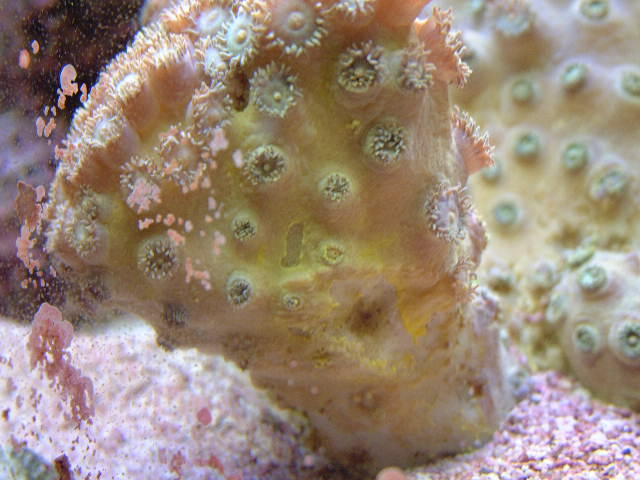
Please help my Pogodo coral, I think it has RTN. I noticed its tissue loss started 2 weeks ago, and progressing upward from the base. Help :cry:

The pogoda is a dyed speciment introduced about 5 months ago. It loss its dye in about 2 months and even grow for about 1 cm. I thought the coral is happy.

Starting 2 ro 3 weeks ago, its polpy was not extending as much and starts to show tissue loss at its base. Tehn the situation get worse everyday, at about half a cm a day.

Here some pic for your reference. Note the base is dying but the top are healthy. Please advice:


This is a 4 year-old reef with 5 small fishes and a few softies, and LPSs. Everyone else is happy.

System is a 65G with 25G sump feed from RO.

Filter is wet/dry, DAS skimmer, live rock and 2" sand bed.

Lighting:2 NO (12 hr/day) and 250 MH (2hr/day).

Input: Feeding once a day and B-Ionic. Biweekly Kent Iodine and Black powder.

Water parameter are not tested as it is a stable system.
 

Attachments

  • dscf0182.jpg
    dscf0182.jpg
    49.5 KB · Views: 1,150
  • dscf0181.jpg
    dscf0181.jpg
    49.3 KB · Views: 1,153
  • dscf0180.jpg
    dscf0180.jpg
    46.4 KB · Views: 1,154

Anemone

Advanced Reefer
Rating - 0%
0   0   0
Well, my first thought is that you may be light-starving the coral by only running th MHs for 2 hours. I'd slowly ramp them up to at least 8 hours.

Next, I'd take measurements of the water parameters. Stable system or not, something may have slipped, and the pagoda may be the first to react. What's the S.G.? How about the pH? Temp? Nitrates? Any of these might stress your coral enough to make it less resistant to disease (especially if it was already stressed by being dyed!). How about your iodine additions - are you measuring the iodine levels in your tank (iodine is a powerful oxydizer/sterilization agent).

How often do you do water changes? Perhaps a large water change might be in order.

Once you get the lighting up, if the recession continues, I'd frag the coral above the die off/healthy tissue interface, and toss the diseased/dying portion.

HTH,

Kevin
 

ronkhoo

Reefer
Rating - 0%
0   0   0
OK, I'll do a WG of 10G tonight.

I heard some people would dip the coral in RO water. Would you suggest this?

If I had to frag it, do I need to seal the broke-off area?

Thanks.

p.s. Did you see my pic is the above post?
 
A

Anonymous

Guest
Rating - 0%
0   0   0
Do the WC

Don't dip the coral in RO. I don't know of any reason why this would help.

And no, no need to seal the broken off area of the coral frag, if you choose to frag it. The coral should re-encrrust the broken off area. Or coraline algea will grown there.

HTH

Louey
 

ronkhoo

Reefer
Rating - 0%
0   0   0
WC is in its way...

I did some test using my Seachem kit and Ho Ray! pH is only 7.9!

What should I do now? What could cause such a low pH?

PH=7.9 8O
SG=1.023(DeepSix), 1.020(Hydrometer)
Ca=400ppm
dKH=3.5mq/L
PO4=0.07ppm
Amo/Nitrate/Nitrite=NIL
 

Leopardshark

Advanced Reefer
Rating - 0%
0   0   0
ok, first of all, 2 hours for your MH is just to little to keep any coral alive, probably you´re starving him.
Second, I think your salinity is way too low, it should be 1.025 or 35 ppt.
The ph is on it´s low side though.
Good luck
 

caecosystems

Experienced Reefer
Rating - 0%
0   0   0
IMO, a specific gravity of 1.023 is not neccesarily low. Yes, I keep my reefs at 1.026 (36ppt) but if his specific gravity is stable at 1.023, no problem would ever be caused there. A pH of 7.9 is not ghastly low, especially depending on when you took this reading, ie at night. Check your pH at the peak of your photo period as well. It looks to me in your photos like a bacterial infection brought on from tissue damage from coral aggression or you may have dropped a rock on it or it went tumbling one day. Take a 5 gallon bucket and fill it with your tank water. Now add 1 drop per gallon of Lugol's Iodine. Aerate the water and let the coral sit in there for about 15 minutes. Waft the infectious parts with your hand under water to help the area clear. Don't ever think that you don't have to test your parameters because your tank is "stable". I would run your halides for about 6 to 8 hours a day, but don't do it all at once. Add 1 hour a week or so to the timer until you reach desired duration. Your specimen of Turbinaria peltata does not look dyed to me. They are usually dyed bright yellow to look like T. reniformis but with the large polyps of peltata.
You don't "have to" frag the coral. Just get the infection off with Lugol's and keep algae off of the exposed skeleton. Turbinaria skeleton is "very" dense and you may cause more harm then good. Good luck.
 

Leopardshark

Advanced Reefer
Rating - 0%
0   0   0
mmm, not exactly,
Lugol contains potassium iodide and iodide and I think that the one ffrom the drugstore has only iodide.
HTH
 
A

Anonymous

Guest
Rating - 0%
0   0   0
It appears to me that the problem is not bacterial/viral. If you notice, the recession is at the bottom of the coral where there is little light. I agree with anemone in that two hours a day is nowhere near enough of a photoperiod for MH. You need at least 6 hours a day but would suggest 8-10 as best. As you can see the coral is expanded around the top where she is recieving light.

As for the PH, many tanks go down to an 8.0 or so at night so a 7.9 is not too far off. Check during your lighting peak, it should be at least an 8.2. Second, I am confused/alarmed at the difference in S.G. readings between the deep six and the glass hydrometer(glass-I assume). If you are accounting for the meniscus and are using still water, the glass hydrometer would be more accurate. If that is the case, a 1.020 is way too low. Even FO tanks are maintained at a minimum of 1.021.

After correcting these aforementioned problems you should see that T. palata is one of the hardiest corals that you'll find. If you still fear bacteria you can do the Lugol's dip, but I would not frag the coral. After the dip any infection should be killed and new tissue will grow over the dead area. Looking at the tissue it looks like it is wearing away without any sign of infection.
 

Sponsor Reefs

We're a FREE website, and we exist because of hobbyists like YOU who help us run this community.

Click here to sponsor $10:


Top