

• Why not take a moment to introduce yourself to our members?

masterswimmer

Old School Reefer
Vendor
Location
NY
Rating - 99.6%
450   2   0
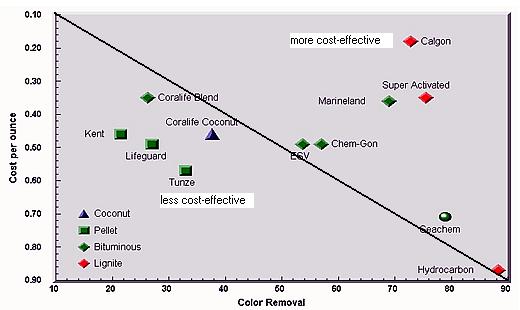
That chart, like the whole article is very misleading. For instance, check the article, ESV (the brand I use) is bituminous. However, the rating (color removal) for bituminous is ~ 15%. ESV on the other hand is ~ 55%.

How can the same material be both 15% and 55%?

I know someone is going to say that also depends on granular size and shape as well. But the chart makes a blanket statement about bituminous being only 15% effective.

Just a very inconclusive article all the way around.

Russ
 

ctxmonitor

Senior Member
Location
Brooklyn, NY
Rating - 100%
79   0   0
pecan2phat said:
Tom,
From my comparison and use, Hydro-Carbon works much better when using a reactor.
I've used both Marine Land (for the cost & effectiveness) and Hydro-Carbon and Hydro-Carbon has very little amounts of granules that float which don't work well in a fluidized reactor. Marine Land on the other hand has a lot of floaties and is best used in a filter bag.

so everyone is agreeing that if you want to use carbon in a fluidize chamber, Hydro Carbon is the way to go?

I think the chart is a bit confusing , as it didn't mention what all the shape and color on the chart mean.
 

alrha

...
Location
Brooklyn
Rating - 100%
85   0   0
ctxmonitor said:
so everyone is agreeing that if you want to use carbon in a fluidize chamber, Hydro Carbon is the way to go?
Nope.
alrha said:
I still prefer the Matrix Carbon over the Hydrocarbon due to its spherical surface for use in my reactor. Also Lignite (Hydrocarbon) is softer and can breakdown/dust easier - especially when used in a fluidized reactor like my phosguard reactor.
 

alrha

...
Location
Brooklyn
Rating - 100%
85   0   0
cali_reef said:
Albert, do your math on this one
you can draw a diagonal line from top left to bottom right.
this will be a line where .10 cost = .10 color all the way to .90 cost = .90 color.

Everything above the line will be more cost-effective (most bang for your buck) than the ones below the line. The further from the line, the better/worse the value (depending on which side of the line).

for ex. Seachem appears a little above the line while Marineland and Superactivated would be way above the line. On the other hand Tunze/Kent/Lifeguard are the least cost effective.

While Seachem is one of the most effective, it is not the best value. nevertheless, i still prefer it for it's shape/type for use in my fluidized reactor.
 

Attachments

  • carbon1.jpg
    carbon1.jpg
    21.1 KB · Views: 113
Last edited:

gettanked

Member
Location
Carlisle, Pa
Rating - 0%
0   0   0
Hey Guys – Here is the formula to choice a good GAC (Granular Activated Carbon):

The smaller the GAC are the more surface area you have.
The bigger your GAC is the less surface area you have.

The larger your GAC is the bigger your voids are
The smaller your GAC is the smaller your voids are.

Remember water always want to take the path of least resistance.

The lighter your GAC is the more pores you have. (pores captures the impurities)
The heavier your GAC is the fewer pores you have.

It’s more efficient to use GAC in a media reactor with the proper water flow.

If you are using a fluid bed reactor, do not let the GAC float around inside the chamber.

Using a nylon bag full of GAC and floating it in your sump is called the passive mode, you are only going to utilize the exterior of the pile of GAC, not the interior of the pouch.

I hope this helps you make a better decision on what GAC to buy.
 
P

Pedro

Guest
Rating - 0%
0   0   0
Just Curious, when in a phosban reactor, you're saying that the carbon should not tumble? I run mine so it tumbles in order to prevent crap from accumulating within. Wouldn't a slight tumble expose the carbon to more water though?
 

Deanos

Old School Reefer
Location
Bronx, NY 10475
Rating - 100%
194   0   0
I use ESV carbon in a Phosban Reactor, a few of which always floats :mad:, even though the flow doesn't cause much tumbling of the non-floaters. I allow for some tumbling , as I thought it was fine for carbon, but not for phosphate-removing products :confused:
 
P

Pedro

Guest
Rating - 100%
194   0   0
Dean, i allow just an ever so slightly tumbling for the phosphate media. I thought that was normal. It just barely moves the top so i know that water is flowing through. None of the particles float. I know the word tumbling seems to imply that the whole surface is moving, but it's not. If it doesn't move, i think it can become solidified. At least that's what i read last time on Rowa.
 

Sponsor Reefs

We're a FREE website, and we exist because of hobbyists like YOU who help us run this community.

Click here to sponsor $10:


Top