






- Location
- staten island

Welcome To the World of Versatility!
By Joshua McMillen
In this regard, we must be able to change, expand or adapt our systems to keep up lest our ideas be placed on a shelf until we can afford to implement them. I would not be surprised to find this as a leading cause in the lack of improvements being made with our home systems. As long as we brood on ideas, and we do brood, we can only hold onto so many before they are replaced by the constant influx of new ones. In this article I hope to make at least one aspect of system design a little easier to implement, as well as completely rearrange at our leisure.
In system planning and setup, I feel there is but one major limiting factor toward this end: Plumbing. More specifically, sumps. Upgrading our sump related equipment, integrating refugia, and any other number of desired changes to them is limited by the much needed system of baffles we employ.
Baffles, as we know, are the wall construction within the sump that moderate and direct the flow of water so as to force air bubbles to the surface, and form a pathway through the desired filtration on its way to the return pump. Once fixed in place, however, we must either make changes as their construction allows, or remove them completely and recreate them. Neither of these can be considered at our leisure.
Traditionally, these baffles are siliconed in place, presenting two problems. First, we must match the materials being used (acrylic to acrylic, glass to glass, Etc.) and of course the obvious, once installed they cannot be moved. As an alternative, I propose a pressure locked/slip fit baffle system, which when properly installed is as effective as a fixed installation, while providing easy manipulation to incorporate a larger skimmer, refugium, pump, Etc.
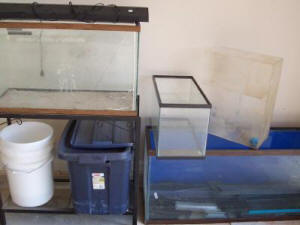
For ease of explanation here, I am going to use an old glass aquarium as the sump vessel. Though these can be installed in virtually any vessel that we use, it would change their construction slightly with the shape of each as you will soon understand.
Materials and Tools Needed
Step 1: Measure
In measuring for the width of your baffles, it is important to remember that you will be measuring the inside width of your sump. This is key as the pressure lock depends on it. Once you have your inside measure (for our example 11 3/4?), you will simply need to subtract ?? to obtain the baffle width (thus 11 ??). This leaves a clearance of 1/8? on either side of the baffle. Next, you will need to determine the height of the baffle. There is no hard set rule on this as the entire operation of this system is open to alteration and adjustment. Again, for ease of explanation, we are merely taming flow in this example. When determining the height, measure from the bottom of the sump (yes, even for the ?under flows?) as this will serve an important safety precaution during operation.
Step 2: Cut
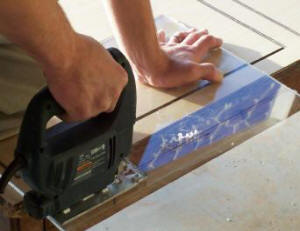
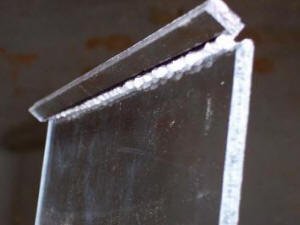
Above Left: Although table and panel saws are necessary for all-acrylic fabrication, a saber saw does a fine job for this type of project. Above Right: Fine tooth blades tend to overheat and melt the Lucite, sometimes actually welding the two pieces back together. Be sure to wear safety glasses!
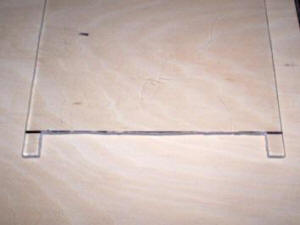
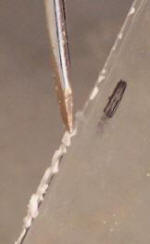
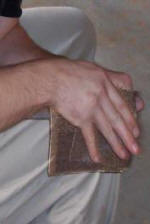
Below Left: An "underflow" baffle with center cut out to leave supporting legs on each side. Below Right: Cleaning up the cut edge with a scredriver and then sand paper.
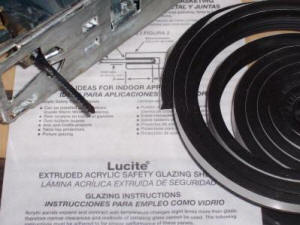
- 1 sheet of ?? Lucite (or any brand of acrylic sheet) measuring 24?x48?. Try your local home improvement warehouse or check the yellow pages under "Plastic Sheet, Rod and Tube".
- 2 rolls of Marine/Outdoor EPDM foam rubber weather stripping. Be sure to choose EPDM. Other materials may deteriorate in water.
- 1 sump. Standard glass aquariums work great and every tried and true fish geek has at least one to spare!
- Power saw. A saber saw is used in this article, but table saws are even better.
- Screwdriver, chisel or scraper and sandpaper.
Step 1: Measure
In measuring for the width of your baffles, it is important to remember that you will be measuring the inside width of your sump. This is key as the pressure lock depends on it. Once you have your inside measure (for our example 11 3/4?), you will simply need to subtract ?? to obtain the baffle width (thus 11 ??). This leaves a clearance of 1/8? on either side of the baffle. Next, you will need to determine the height of the baffle. There is no hard set rule on this as the entire operation of this system is open to alteration and adjustment. Again, for ease of explanation, we are merely taming flow in this example. When determining the height, measure from the bottom of the sump (yes, even for the ?under flows?) as this will serve an important safety precaution during operation.
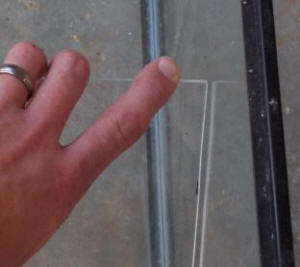
The baffle in the picture has been properly measured and cut. The space shown will be filled by the seal.
Step 2: Cut
Above Left: Although table and panel saws are necessary for all-acrylic fabrication, a saber saw does a fine job for this type of project. Above Right: Fine tooth blades tend to overheat and melt the Lucite, sometimes actually welding the two pieces back together. Be sure to wear safety glasses!
Below Left: An "underflow" baffle with center cut out to leave supporting legs on each side. Below Right: Cleaning up the cut edge with a scredriver and then sand paper.
Cutting the Lucite will likely take some experimenting so be sure to take a few practice runs on a scrap section. Though the label states to use a fine tooth blade, I found it to be much easier with rough, wood cutting blades. This seemed to cut wide enough to prevent the edges from melting back together as the blade passed. The cutting of the baffles is fairly straight forward with one exception; the under flows. Once the initial rectangle has been cut, it will be necessary to cut an additional 1?x9? section (centered) out of the bottom edge. This opening serves two functions. It, of course, forces water to pass under the baffle, while the resultant ?legs? on each side provide support. This ensures that directional flow is always maintained, since the baffle cannot inadvertently drop or be pressed into the bottom of the sump.
Step 3: Apply EPDM
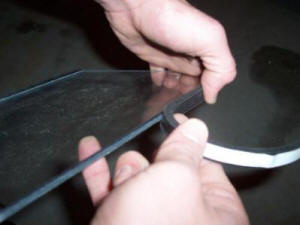
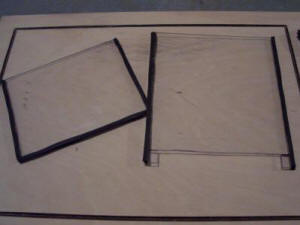
This is the final step in construction of the baffle itself. Simply put, it?s like using a sticker. For the over flow walls you will be covering three sides; left, right and bottom. The left and right sides should be covered from top to bottom and the excess cut flush at these edges. The bottom should be covered from left to right, extended beyond the baffle, and cut off flush with the outside edge of the side strips. This creates a full seal across the bottom eliminating any gaps at the corners. The under flow walls only need to be covered on the left and right sides, in the same manner. The EPDM strips will add a ?? to each side of the baffle making them wider than the sump vessel. When installing the baffle, the compression against these will create the pressure lock. This will insure hold and create a water-tight seal for proper function.
Left: Carefully applying the EPDM strip to the edge of the baffle. Right: A bottom sealing baffle and under-flow baffle are shown.
Step 4: Install and Test
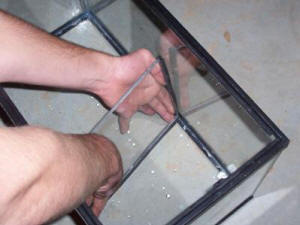
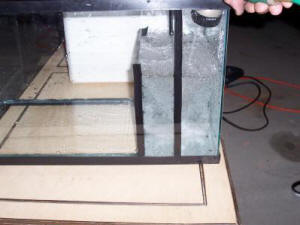 Installation is a snap. Using a small amount of water, wet the inside surface of the sump as well as the EPDM strips. Left: Angle the baffle into the desired position. While holding one end stationary, simply tap the other end into place. Right: Baffles in place!
Now my friends, you are finished. What you are left with is a fully functional yet extremely versatile system of baffles. Make it what you will, removal and adjustment take only minutes. Wonder if a refugium might be useful? Try it! Want that bigger skimmer you?ve been drooling over? Buy it! It is now truly up to you!
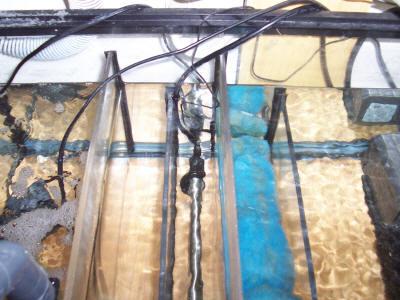
A completed baffle system that can be easily rearranged anytime the owner desires!
Last edited: