

- Location
- Connecticut
Updated Version.
Can three days without light kill red slime causing cyanobacteria? Does the elimination of such a tenacious pest by this method seem a little too easy? What actually happens to a colony of cyanobacteria (Spirulina) when it is placed in the dark? Here is how started to answer these questions.
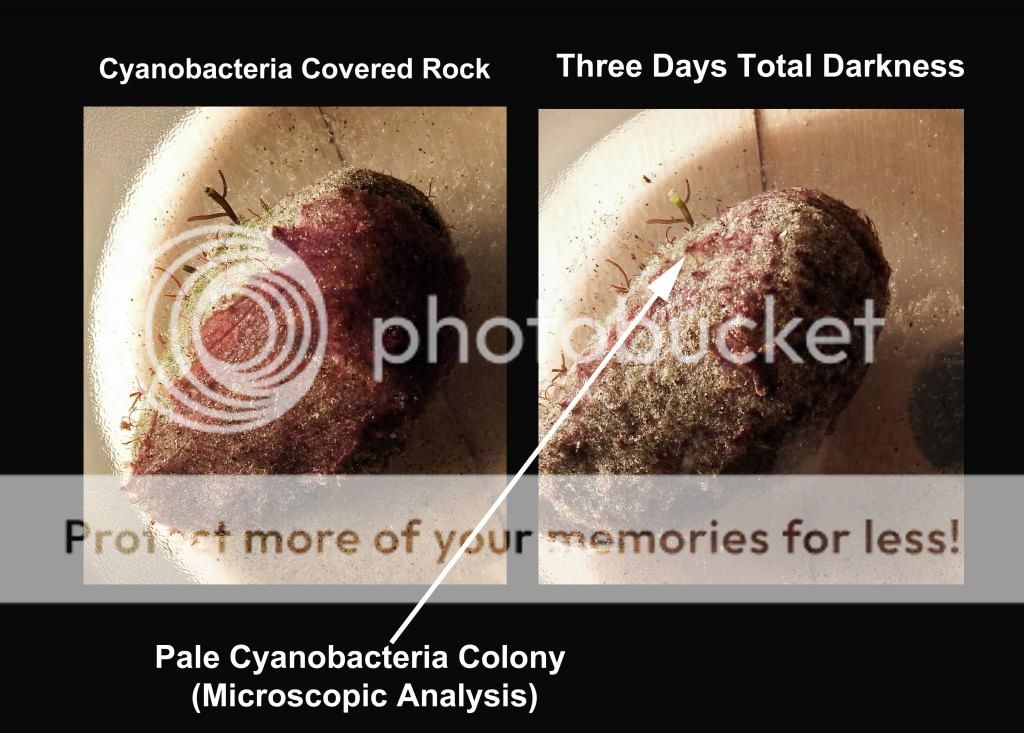
Here is what happens to a red slime covered rock after three days in the dark. Close examination shows that the mat shrinks but is not totally eradicated.
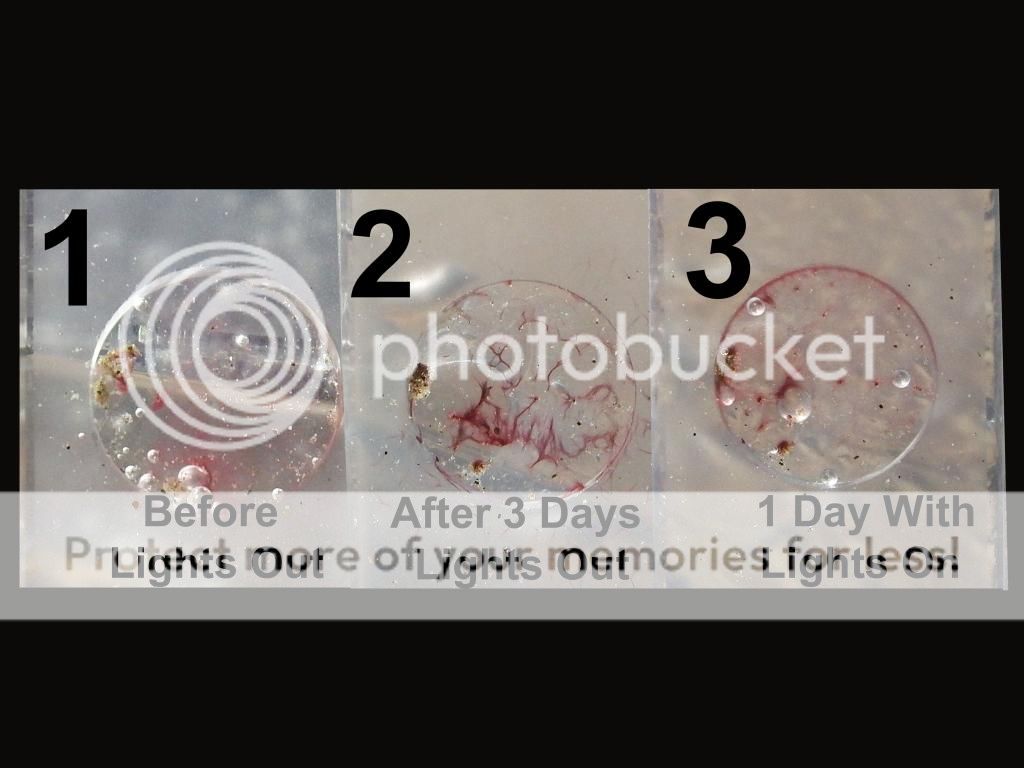
To enable a microscopic analysis of the mat before and after "lights out", a small piece of red slime was removed from a rock and placed in a deep well slide and the slide was slowly lowered into about a quart of tank water and placed under the refugium light for a 24 hours. Within an hour the colony expanded beyond its original perimeter and became attached to the well. The colony also developed bubbles indicating that it was still alive. The next day after about two hours under the sump light (Image 1), the slide was transferred to a six ounce dish containing fresh tank water and stored in the dark. After three days in total darkness, the colony had formed red stringy aggregates. (Image 2). The bacteria looked normal under the microscope but the filaments aligned in clumps. The water was replaced with fresh tank water and the container placed under the refugium light. Within two hours, bubbles began to appear, indicating tha bacteria were alive. Twelve hours later, the stringy clumps were mostly dispersed (Image 3). Clearly the bacteria were not all dead, but what is happening in the aquarium to make it appear that the bloom had been wiped out?
Maybe the stringy clumps do not attach to aquarium surfaces as strongly as the original red slime mat and are subsequently dislodged and dispersed by water currents in the aquarium. Mechanical filtration and skimming might then remove these clumps from the water. This scenario, where the cyanobacteria mat is dispersed rather than killed, also explains why in many cases the red slime returns. Mechanical filtration does not entirely remove the dispersed cyanobacteria.
More experiments are needed to confirm these observations. Comments and suggestions are welcome.
Can three days without light kill red slime causing cyanobacteria? Does the elimination of such a tenacious pest by this method seem a little too easy? What actually happens to a colony of cyanobacteria (Spirulina) when it is placed in the dark? Here is how started to answer these questions.
Here is what happens to a red slime covered rock after three days in the dark. Close examination shows that the mat shrinks but is not totally eradicated.
To enable a microscopic analysis of the mat before and after "lights out", a small piece of red slime was removed from a rock and placed in a deep well slide and the slide was slowly lowered into about a quart of tank water and placed under the refugium light for a 24 hours. Within an hour the colony expanded beyond its original perimeter and became attached to the well. The colony also developed bubbles indicating that it was still alive. The next day after about two hours under the sump light (Image 1), the slide was transferred to a six ounce dish containing fresh tank water and stored in the dark. After three days in total darkness, the colony had formed red stringy aggregates. (Image 2). The bacteria looked normal under the microscope but the filaments aligned in clumps. The water was replaced with fresh tank water and the container placed under the refugium light. Within two hours, bubbles began to appear, indicating tha bacteria were alive. Twelve hours later, the stringy clumps were mostly dispersed (Image 3). Clearly the bacteria were not all dead, but what is happening in the aquarium to make it appear that the bloom had been wiped out?
Maybe the stringy clumps do not attach to aquarium surfaces as strongly as the original red slime mat and are subsequently dislodged and dispersed by water currents in the aquarium. Mechanical filtration and skimming might then remove these clumps from the water. This scenario, where the cyanobacteria mat is dispersed rather than killed, also explains why in many cases the red slime returns. Mechanical filtration does not entirely remove the dispersed cyanobacteria.
More experiments are needed to confirm these observations. Comments and suggestions are welcome.
Last edited: