
• Why not take a moment to introduce yourself to our members?

Dan_P

Advanced Reefer
Location
Connecticut
Rating - 0%
0   0   0
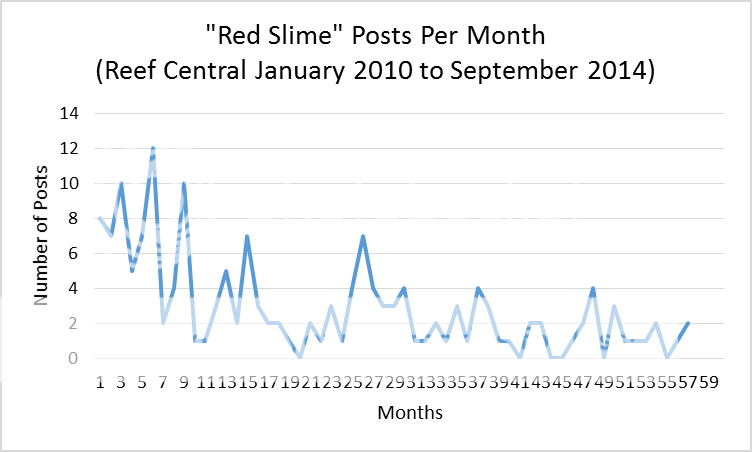
This is a review of almost five years of Reef Central posts that were retrieved with the search term "red slime". The first plot below shows the monthly total number of posts from January 2010 to Septembe 2014. These monthly totals are actually based on the "latest post" which was a short cut for counting. This introduces some error because there is the occasional post that goes beyond a one month duration. Also, I did not find and remove the occasional vendor post that were included in the search results. With those caveats in mind, the plot shows that red slime remains a popular topic.

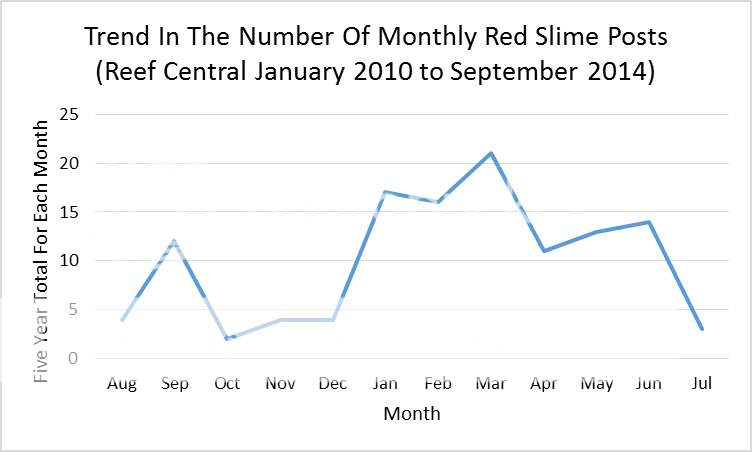
There has been the occasional claim that red slime attacks are seasonal. If there is a connection between when red slime appears in the aquarium and posting a request for help, then we might see a peak in the monthly posts during the purported "cyano season". The second plot does seem to show a peak in the monthly posts. Peak location is approximate because of the above caveats about the data and an aquarist might not post until after red slime has expanded And because experienced aquarist are less likely to request help dealing with red slime, the data is also likely to be biased toward new aquarists and new aquariums. Interesting all the same.

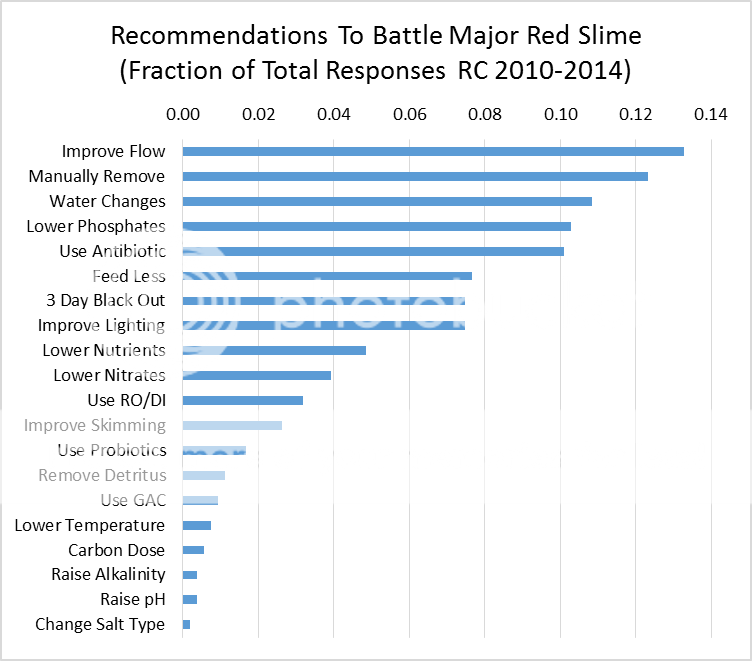
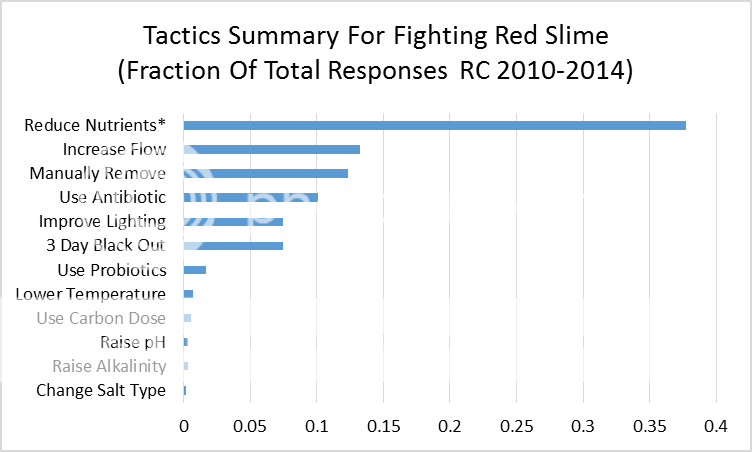
"What we recommend" to fight red slime is shown in the third chart. These are tactics recommended by members who submitted responses. There is likely to be some double counting because the same members respond to multiple requests for help. The data is also biased in another way. Not everyone in the forum responds. The data likely reflects the tactics of the vocal minority, though it is consistent with the information found in books and online articles. The fourth chart clarifies the data further by combining similar tactics under the recommendation heading "reduce nutrients". This aggregated tactic becomes the most recommended tactic to fight red slime.

Does reducing nutrients really work or does the red slime plague just burn itself out? Hard to say because there is rarely a followup to a post for help. Adding to this, many aquarist will try several tactics at once which then makes it impossible to establish a solid cause and effect link between nutrient reduction and red slime disappearing. While nutrient reduction is a rational approach with no apparent downside to the tactic, it alone does not seem to explain the appearance and sometimes explosive growth of red slime.

New tanks, regardless of low nutrients levels, always seem to be more susceptible to red slime formation than established aquariums with the same nitrate and phosphate levels. A new aquarium or sump, plumbed to an established aquarium with no red slime issues, often has a vigorous growth of red slime soon after the hook up. Clearly, the trigger for red slime blooms is not simply a reflection of bad housekeeping, although sometimes it sure seems that way.

Suggestions always welcome.

Dan
RedSlimePosts_zpsf1dd78fc.png


MonthlyPostTrend_zps8b2f430a.png


Recommendations_zps2a12ecb0.png


TacticsSummary_zps4ea58d19.png
 
Location
Brooklyn, NY
Rating - 97.4%
74   2   0
A very interesting compilation of data Dan. I would concur from personal experience --yes, yes anecdotal evidence! :) that the increase of cyano in the spring months is real at least here in the NE. I also concur that it is a confounding and mysterious thing often disappearing as mysteriously as it appears. Furthermore, pretty much all of those recommendations work some of the time, but none other than antibiotics work all of the time. Fun hobby right? :)
 
Location
GARDEN CITY
Rating - 100%
45   0   0
Thank you for all the work you took to create the interesting charts that could be very helpfull to everybody. In my opinion it is seasonal, it gets triggered by temperature. What I wonder is who gets it more, tanks with open top or closed tops.lfs places have open tops most of the time and they always get it seasonal so is it when they turn the heat on or air condition. My tank have always been with glass tops and I do have a chiller to keep steady temp but when I do water changes in the summer the new mix is always warmer than my tanks water. Only in the summer I get very light discoloration on the sand every now and then, but never had a bloom of it. Just my two cents
 

Dan_P

Advanced Reefer
Location
Connecticut
Rating - 0%
0   0   0
Thank you for all the work you took to create the interesting charts that could be very helpfull to everybody. In my opinion it is seasonal, it gets triggered by temperature. What I wonder is who gets it more, tanks with open top or closed tops.lfs places have open tops most of the time and they always get it seasonal so is it when they turn the heat on or air condition. My tank have always been with glass tops and I do have a chiller to keep steady temp but when I do water changes in the summer the new mix is always warmer than my tanks water. Only in the summer I get very light discoloration on the sand every now and then, but never had a bloom of it. Just my two cents

Thank you for comments. Good food for thought. Here are two more ideas.

During the heating season, homes can accumulate CO2 often driving down aquarium pH. Cyanobacteria uses CO2 as a carbon source. It would be interesting to see if this happens in southern US.

During the winter, aquarists are cooped up in the house and may feed the aquarium more or more often.

Light has been suggested as a trigger. I haven't found any science on this for cyanobacteria, but who knows.
 
Location
GARDEN CITY
Rating - 100%
45   0   0
Dan there is a tank in a car wash near by, the tank is see true. One side is towards the cashier and main entrance and the other side is to the waiting room which is surrounded by glass and light. The funny thing as long as I know this tank always gets cyno on the side of the waiting room [surrounded with glass=light] and not the other. Its amazing when you see this cause its like two tanks, one dirty and one clean. So light do have something to do with it. I always tought the soap, chemicals used in this car wash that are airborn that possibly are the reason and offcourse the tank dont have glass covers.
 

jrobbins

Advanced Reefer
Location
New York
Rating - 100%
95   0   0
its interesting but you really need to know the ratio of 'red slime' posts to the overall number of posts in any given month. it could actually be the opposite of what it looks like now if the volume of posts in the winter is much greater than in the summer.
 

Dan_P

Advanced Reefer
Location
Connecticut
Rating - 0%
0   0   0
its interesting but you really need to know the ratio of 'red slime' posts to the overall number of posts in any given month. it could actually be the opposite of what it looks like now if the volume of posts in the winter is much greater than in the summer.

Your are correct!

I will see what I can do. Maybe I could obtain the monthly totals from the moderators.
 
Location
GARDEN CITY
Rating - 100%
45   0   0
Dan you have spent a lot of time researching this which I think every reefer like myself should be greatfull. I think you are on to something cause you have the right approach. I do believe its temperature related, I am not saying thats the cause but it could very well be the trigger and then light contribute to it. Most of us feed our tank and also add amino acids which in theory we will be feeding the cyano at the same time and then wonder why we cant get rid of it. How many people who posted that they have a cyano issue have chillers, probably one in ten, I gaurantee you will find that there are less people getting cyano in winter cause the temperature in homes are more consistent than summer even though reallisticly we keep our homes same temperature in summer and winter or close to it.Every body have heat in their homes but not every body have central air which means the tank is isolated in a basement or in a room that window A/C is not kept on all day and night. The chiller become the tank's A/C but as I read tank threads I noticed that some people dont have a chiller and thats why if its temperature related it would probably be bigger percentage of cyano outbreaks in the summer. Thank you for your good work
 

Dan_P

Advanced Reefer
Location
Connecticut
Rating - 0%
0   0   0
How many people who posted that they have a cyano issue have chillers, probably one in ten, I gaurantee you will find that there are less people getting cyano in winter cause the temperature in homes are more consistent than summer even though reallisticly we keep our homes same temperature in summer and winter or close to it.Every body have heat in their homes but not every body have central air which means the tank is isolated in a basement or in a room that window A/C is not kept on all day and night. The chiller become the tank's A/C but as I read tank threads I noticed that some people dont have a chiller and thats why if its temperature related it would probably be bigger percentage of cyano outbreaks in the summer. Thank you for your good work

Excellent point!

I think your intuition about chillers is right. I need to revisit the data.
 

KathyC

Moderator
Location
Barnum Island
Rating - 100%
200   0   0
I've always thought it was more due to closed doors/windows than AC. (not regarding pH variations necessarily, just about exchanging the air in a home)
Then you have some AC units that cool outside air and bring it in, and others that are cooling the current room air... so new air vs old air.


...Although pH could play a role but you wouldn't have access to data on how many people are in a home, or if the tank might be a in a room where excess CO2 levels aren't realized.


Could be about humidity levels too. I know I have to change out my shower curtain liner a few times a year as it develops pink 'stuff' on it - and I'd almost swear its cyano...you'd be welcome to the 'goo' from it if you'd like to look at it under a microscope :)


As cyano bacteria is so prevalent on our planet, perhaps we are introducing it to our tanks by first having it elsewhere in our environment and when the level gets high enough, it settle onto the surface of our tanks and there we are providing the perfect ingredients to feed it..water and the perfect spectrum of lighting.


Good luck in your search!
(maybe a search of MR posts on the topic? :))
 

NYreefNoob

Skimmer Freak
Location
poughquag, ny
Rating - 99.4%
168   1   0
dan ty for taking the time to do this. I think there are several things affected by the seasons. as well as another angle to look at is if people had recently added any new corals to their tanks, especially from austalia. the reason I bring that up is a few years back when the chalice fad hit there was a lot coming from aust and people were starting to notice die off and corals that had been in the tank starting to do it as well. I still get small patchs from time to time in my tank, as I had told you I have no direct sunlight on my tanks, I run led's have a lot of flow, and as far as nutrients I would say I am very low, takes a couple days to have any type of algea on glass and realistically takes about 10 days before I need o clean glass, only have 3 fish. I don't use carbon or gfo and feed a cube of frozen each day
 

Dan_P

Advanced Reefer
Location
Connecticut
Rating - 0%
0   0   0
Could be about humidity levels too. I know I have to change out my shower curtain liner a few times a year as it develops pink 'stuff' on it - and I'd almost swear its cyano...you'd be welcome to the 'goo' from it if you'd like to look at it under a microscope

The "pink fink" blossoms in the mortar of my rockwall foundation but nowhere else in the house. Go figure!

I have yet to come across any information that suggests cyanobacteria are not in our aquariums all the time. In fact, the more I read, the more that it seems that cyanobacteria should be in a healthy aquarium!

So, the search continues for triggers. Thanks for your thoughts. Suggestions and ideas are a big help.
 

Dan_P

Advanced Reefer
Location
Connecticut
Rating - 0%
0   0   0
... as far as nutrients I would say I am very low, takes a couple days to have any type of algea on glass and realistically takes about 10 days before I need o clean glass, only have 3 fish. I don't use carbon or gfo and feed a cube of frozen each day

You bring up a good point here. We develop a reasonable sense for estimating nutrient levels in our systems through the observation of the health our tanks. To understand what triggers red slime attacks, we might need a more quantitative estimate.

Cyanobacteria not only assimilate CO2 but can also use organic compounds as a carbon source. If these compounds play a role comparable to NO3 and PO4 in stimulating red slime, then some of the mystery behind what triggers red slime might be reduced or eliminated by knowing these levels. It might also be useful to know these levels for coral nutrition.

Keep the ideas coming. They are helping.
 

Sponsor Reefs

We're a FREE website, and we exist because of hobbyists like YOU who help us run this community.

Click here to sponsor $10:


Top