


Wanted to review some benefits of a baffle refugium in this thread.
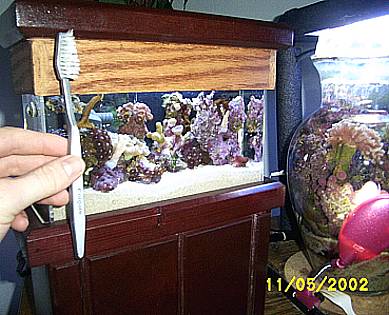
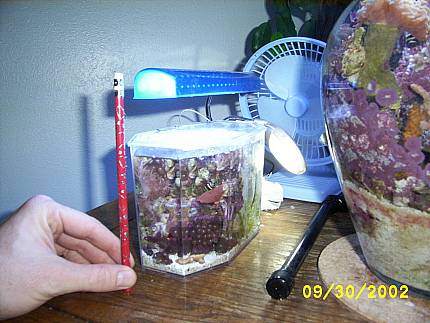
I tried this idea because there was a need for constant oxygen production within a completely sealed environment--its the only way you can pico reef without maintenance hassles. The pic featured later on, the one of the condensation, is what it looks like after running sealed--oxygen and carbon dioxide are not exchanged with the external air in this design. This seems to be the right proportion of macro algae for the given bioload.
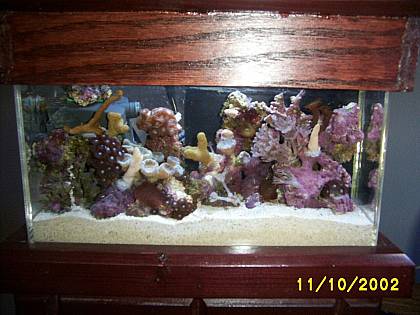
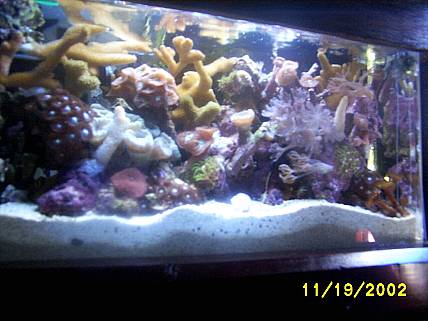
I currently have (all very very small frags) Blastomussa, GSP x2 var., three red/blue mushrooms, yellow Montipora x2<--- *my fav
pink and brown Montipora, ten small heads of Caulastrea, three var. Zooanthids, pulsing Xenia, Anthelia and Clavularia. Of course the specimens will be fragged/relocated as needed-- and its not as often as one might suspect.
For the first time, the sealed reef design was 100% effective and easy to achieve with some Home Depot weatherstripping--there was a small erasable marker line where the water level was, and it never dropped. I do dose it every four or so days through a corked hole in the back. It needs 10-15 drops of carbonate every four days or so and the pH is very stable from day to night.
Oxygen production had to be constant throughout a given 24 hour period. In a three-quarter gallon reef there is not much water column left over after you plumb it, stock it with LR and specimens and finally add sand. That actual water column is somewhere around 25-30 ounces I would guess.
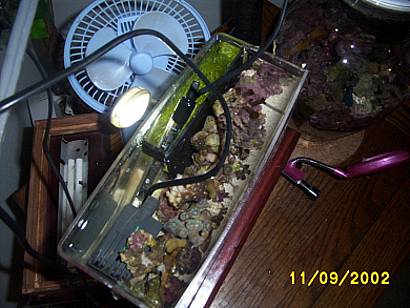
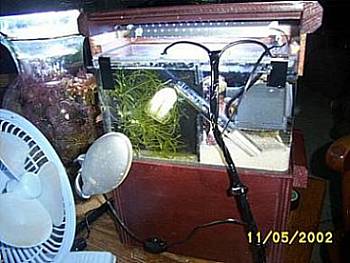
Plumbing these tiny tanks is not fun, and prone to leaks. They are harder to seal when you are working with two different tanks...so the refugium had to be internal. It was then easy to see that you could make a very thin refugium, but have much surface area for light penetrance if you light it from the side. **Azoo palm light-miniature 7 watt power compact 7700 kelvin rating
Salt creep does not happen if you don't give the capillary action a chance to start: the water line is 1/2 inch below the seal and no caulerpa fronds are allowed to touch the seal.
heres the pics:
Brandon M.
I tried this idea because there was a need for constant oxygen production within a completely sealed environment--its the only way you can pico reef without maintenance hassles. The pic featured later on, the one of the condensation, is what it looks like after running sealed--oxygen and carbon dioxide are not exchanged with the external air in this design. This seems to be the right proportion of macro algae for the given bioload.
I currently have (all very very small frags) Blastomussa, GSP x2 var., three red/blue mushrooms, yellow Montipora x2<--- *my fav
pink and brown Montipora, ten small heads of Caulastrea, three var. Zooanthids, pulsing Xenia, Anthelia and Clavularia. Of course the specimens will be fragged/relocated as needed-- and its not as often as one might suspect.
For the first time, the sealed reef design was 100% effective and easy to achieve with some Home Depot weatherstripping--there was a small erasable marker line where the water level was, and it never dropped. I do dose it every four or so days through a corked hole in the back. It needs 10-15 drops of carbonate every four days or so and the pH is very stable from day to night.
Oxygen production had to be constant throughout a given 24 hour period. In a three-quarter gallon reef there is not much water column left over after you plumb it, stock it with LR and specimens and finally add sand. That actual water column is somewhere around 25-30 ounces I would guess.
Plumbing these tiny tanks is not fun, and prone to leaks. They are harder to seal when you are working with two different tanks...so the refugium had to be internal. It was then easy to see that you could make a very thin refugium, but have much surface area for light penetrance if you light it from the side. **Azoo palm light-miniature 7 watt power compact 7700 kelvin rating
Salt creep does not happen if you don't give the capillary action a chance to start: the water line is 1/2 inch below the seal and no caulerpa fronds are allowed to touch the seal.
heres the pics:
Brandon M.