• Why not take a moment to introduce yourself to our members?

texman

Advanced Reefer
Rating - 0%
0   0   0
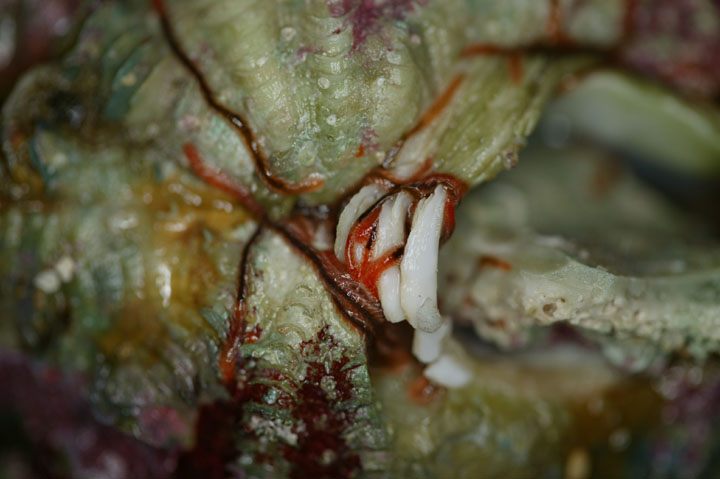
I have had several episodes of clam wipeouts. After the last one, my two Gigas have been thriving for 4 months. I decided to add a few maximas to see what happens. They did well for about 2 weeks, but then started dying, one at a time. I removed one clams after it was dead and could not see any organisms, but removed one today that was still partially alive. It was covered in these bristelworms (?fireworms) Another maxima which is still in good shape has no worms on it. Are these worms known to travel in packs, individually targetting clams with mass attacks? OR Are the worms just attacking clams that are already sick for another reason?

clam-worms.jpg
 

fungia

Advanced Reefer
Rating - 0%
0   0   0
8O

i have no idea but those are scary looking. and i thought worms were our friends now adays! could they have been only scavenging?
 

Len

Advanced Reefer
Rating - 0%
0   0   0
Do you still have the shell to examine? I've seen worms that bore through shells of Tridcanas and eat them inside out. I wonder if there are any holes in the shell of the deceased. They could've also possibly crawled through the exposed foot.

Then again, fungia's guess that the worms are simply scavangers preying opportunistically on a dying clam is a possibility. But I also think there's sufficient concern that these worms could be what's killing your clams.

fungia,
Not all worms are good guys :) It used to be a common misunderstanding that they're all bad guys. Recently, it's the exact opposite. Truth is somewhere in the middle.
 

Adrian

Experienced Reefer
Rating - 0%
0   0   0
Most likely the worms were just scavenging. Whats your set up, lighting and Ca and alk supplementaion specifically? Where are you placing the clams?
 
A

Anonymous

Guest
Rating - 0%
0   0   0
Are you keeping them on the substrate or on the rockwork. I only have one maxima but my sandbed is crawling with critters. I know they are supposed to leave healthy clams alone but I put him on the rockwork and he has great color and mantle extension - my hippopus is on the sand but seems no worse for the wear after one year there.
 

texman

Advanced Reefer
Rating - 0%
0   0   0
I have a 500g tank with nominal parameters and adequate lighting, bla, bla, bla. The tank has been running for almost three years and I have tried clams on several occasions with the same result every time. This is what happens: I buy one maxima and leave it for a few weeks. After I think that everything is OK, I get a few more. Some of them actually show some growth. I generally place my maximas in the sand along with a few derasas and 2 gigas which have always done well. Then, suddenly, overnight, one maxima dies. I have dissected them only to find a few worms and amphipods inside. (there are no holes in the shells) The next day, another clam is dead, followed by one more clam a day later. Clams seem to die in a linear fashion (ie one at a time and seems to affect the closest clam to the dead one, next) I have always felt that I have some sort of predator in the tank which kills the clams, since an infectious process would tend to spread logarythmically (ie 1 followed by 2, followed by 4 etc) I have never seen little white snails or crabs or fish bothering the clams, however have seen these worms on several occasions. I am now almost sure that these worms live peacefully in the sand, but when they find a maxima or crocea clam, they release some sort of chemical which brings the others in, in droves. I am not sure why the gigas and derasas have been spared, but it must have to do with the fact that those clams do not have as much of a byssal opening. In any case, unless I figure out how to get rid of those worms, I guess that I can not longer keep maximas or croceas. [/i]

 

Adrian

Experienced Reefer
Rating - 0%
0   0   0
I have had similar experiences with T.maxima, they seem to do great for a few months, and then overnight they are dead. At first I thought it was bristle worms like your seeing, hords or them would crawl out of the empty shell. Then the same thing happened to a squamosa I kept fo over a year, and there were no bristles. I also kept my maximas on the sand, although every thing ive read on them says they will bore into rock or coral heads as mentioned above. The squamosa was constantly being moved, i have a rather large convict gobie that loves to dig, and one of his caves happened to be right behind the squam and as it got bigger, the clam started to fall in. I think stressed was what killed my clams, in the case of the maximas they were always falling on their sides, probably searching for a suitable substrate to attach to, and with the squam the stress of falling into the caves and then trying to get out. I asked about your lighting and ca&alk because if these arent up to par the clam dosnt have much of a chance to begin with, I also think frequent feedings of phytoplankton are benificial. Of course the amount of lighting depends on the sp. of the clam, but most clams will do better under intense lighting, especially maxima and crocea. HTH
 
A

Anonymous

Guest
Rating - 0%
0   0   0
If you dont see noticable shell growth all the time, you have a problem, could you shoot a pic of the empty shell? The color & new growth will say alot towards the overall health of the clam.

Maxima's and crocea's belong on rocks not sand fwiw, if happy they will quickly attach firmly.
 
A

Anonymous

Guest
Rating - 0%
0   0   0
There wasn't any sign of that disease that was killing clams in recent years? Pinched mantles?
 

texman

Advanced Reefer
Rating - 0%
0   0   0
I have pretty bright lights (4X400W 10000K Halides + 10 X 55W Actinic PC's) This recent batch of maximas has not shown much growth since they have only been in the tank for about 1 month. They were looking great until they started dying. I have had the "pinched mantle" thing happen in the past and tried dipping the clams to no avail. I still think that these worms are predatory (or something else in the tank is) If my tank was suffering from not enough light, improper chemical balance, pH probs, temperature probs etc, etc, then all clams should be affected equally. As mentioned, this is the third seperate incidence where the clams are being wiped out, one at a time. I now have one maxima left. My derasa and two gigas are still looking perfectly fine.
 

Robin Goodfellow

Experienced Reefer
Rating - 0%
0   0   0
hi.
My opinion is that the worms has nothing to do with your problem.

MegaDeTH asked a very important question. If you don't see the clams growing, and laying new shell, you should be concerned.

now have one maxima left. My derasa and two gigas are still looking perfectly fine.

So are they growing?
 

klingsa

Experienced Reefer
Rating - 0%
0   0   0
I've read this thread, and now I'm getting worried! I have a clam incoming this week, and it's the first I've tried to keep. I know I have a lot of bristleworms, which in my experience have never been anything but scavengers. Squamosa's are sand dwellers, right? But I'll put it on the rocks if it keeps the worms away, although the worms are on the rocks as well. Can someone give me some basic clam advice? The tank has been stable for a year - 75 gallons, 20 gallon sump with protein skimmer, lots of water movement, 2 250watt metal halides and a 40 watt actinic. Water conditions - 81 degrees F, spec grav 1.023, nitrates 0, pH 8.3, dKH 9. I add daily calcium supplements, and other trace elements I've had a lot of experience with corals, but haven't kept clams yet. Any tips would be highly appreciated!
Thanks!
Sara
 

Saltykirk

Experienced Reefer
Rating - 0%
0   0   0
I have had the same problems w/ clams as well. I wouldn't think that a population would explode if there were not any food to support it. I have seen lotsa worms on my dead or dying clams too. I think the worms are doing what they do best, scavenging.
 

JeremyR

Advanced Reefer
Rating - 0%
0   0   0
Those particular worms in the photos are scavengers.. I think it's more likely in this case that the maximas brought something in with them IE the clam disease. I've learned the hard way not to buy ANY clams from a wholesaler that stocks pohnpei clams. Sooner or later you get burned.
 

EmilyB

Advanced Reefer
Rating - 0%
0   0   0
technoshaman":em5res04 said:
my hippopus is on the sand but seems no worse for the wear after one year there.

I thought I was the only person in the world with a hippopus. Everyone makes fun of it.. :roll:
 

Adrian

Experienced Reefer
Rating - 0%
0   0   0
Hey Ive got a hippo too, everyones asks "is that a clam", "yes", why did you buy it? Its so plain". I guess some people just dont get it :wink:
 

Sponsor Reefs

We're a FREE website, and we exist because of hobbyists like YOU who help us run this community.

Click here to sponsor $10:


Top