

• Why not take a moment to introduce yourself to our members?

tripsied

Experienced Reefer
Rating - 0%
0   0   0
Continuation from a different thread http://reefs.org/phpBB2/viewtopic.php?t=38676

Background
I recently (last week) purchased a "lollipop" tang. I had never heard of the fish before, but liked him and bought him. He had been in the store for several days and ate like he should and everything seemed fine. When I got the fish home, I decided to look up "lollipop" tang and had no luck finding anything at all.

I recently came across the thread above and found via Minh Nguyen that the fish is in fact an Acanthurus japonicus, aka white-faced surgeonfish.

He seems to be a happy little fellow, though when he came home he had a spot above his right fin that I had not noticed in the store. (looked similar to a bruise) The spot looked like a brown spot on a banana (I figured he banged himself on a piece of rock), it cleared up in 2 or 3 days. Another spot of similar type has appeared on the same side, however, this one is below the fin and there is now (11:54 PM) one under the dorsal fin as well. He and a bullet goby where at odds for the first few days and seems to do reasonably well together now. I am not inclined to think that this spot is the result of them "going at it"

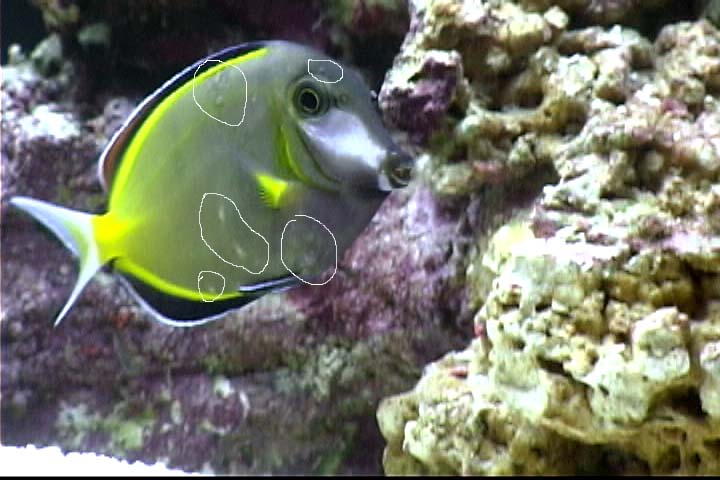
The tang is now developing several light patches on his skin, with a small white dot on the left fin. To me this sounds like ich. If such is the case, then this weekend he is going into a quarrantine tank (as outlined in the August issue of ReefKeeping Magazine http://reefkeeping.com/issues/2003-08/sp/index.htm and getting hyposalinity treatments. :(

Does this sound like ich? Any ideas on what the patch could be. I added a photo of the affected areas. The pic shows the affected areas.

Update: 11:46 PM

The tang seems to have "lost" the white spots (or I simply can't see them, as I have turned the lghts off in order to reduce stress), however, its belly is now a light purplish color and seems swollen. The white part of its cheeks seem pink. Breathing is rapid at times then returns to normal. It seems as if he has diarrhea (if such a thing is possible with fish) as he expelled fecal matter in a rather large cloud and not the usual "string". I am unsure if this is normal in tangs, but I don't think it is. He has become very jumpy and hides if I come near the tank, where he was NOT doing this earlier. He is obviously under some major stress.

I am preparing a quarrtine/hospital tank in the morning when the LFS opens. For now I have an bubbler in the tank to hopefully some respiratory distress.

Any suggestions would be extremely welcome!!!!!!!!!

Lighting - Coralife PC Fixture (65 Watt Actinic and 65 Watt 10K)

Water Parameters
Nitrate 20 (ppm)
Nitrite 0 (ppm)
Total Hardness (??) 250
Total Alk - 180 (ppm)
pH - between 8.0 and 8.4
Specific Gravity - Unknown (hydrometer cracked, replacing this weekend)

Other Issues
My girlfriend brought a Koran Angel home 3 days ago, adjusting well, has a tiny white spot on the ends of both fins, but that is the only external issues.

Food

I have been rolling up small sheets of Seaweed Selects (Green Marine Algae) from Ocean Nutrition which he has been eating like a pig. I have also been using Bio-Blend from Marineland Labs (a small pellet) as well as Wardley's Tropical flakes. I have ben dosing the tank with Coral Accel from Kent, as well as Micro-Vert from Kent as well.

Reef Supplements

I add Reef Complete (1 capful. liquid) twice a day
Reef Builder weekly (Sundays during water change)


Thanks for any help, it is appreciated
 

Attachments

  • dizzy 3.jpg
    dizzy 3.jpg
    47.8 KB · Views: 1,531

hdtran

Advanced Reefer
Rating - 0%
0   0   0
Good luck with Dizzy! I hope he or she gets better!

Fenner's "Conscientious Marine Aquarist" recommends quarantine or dip first, then, second resource, treatment with copper in a treatment tank. Supplementing with vitamin C is also recommended. But he does warn against chronic copper, as it would harm the intestinal fauna.
 

Expos Forever

Advanced Reefer
Rating - 0%
0   0   0
Tommy

Your tang most certainly has ich. While hypo-salinity is effective it must be done carefully with a quality refractometer. Swing-arm hydrometers are not accurate enough.

You seem to really care for your fish so please take the following advice as it's intended: It appears these fish are in a 20 gallon tank (that's been running less than a month). If this is the case your tank is much too small for your tang or angelfish, both these fish require (much) larger tanks. Another issue that I mentioned in the other thread is that it is very important to do research before making a livestock purchase... I'm sure your girlfriend meant well but animals as gifts can cause problems. You would definitely would not be the first person to succumb to bad LFS advice and impulse purchases, but IMO the only proper thing to do would be to return these fish to the LFS. If they'll give you credit get a good book, for example: The Conscientious Marine Aquarist by Bob Fenner. If ever in doubt about a purchase feel free to come here and ask (first!). Many "Dizzys" die every day (and for the one in your tank several others likely died on the way). Too many of these deaths could have been avoided with proper research. It's our duty as reefkeepers to properly care for the animals we are removing from the reef. Good luck. :)
 

tripsied

Experienced Reefer
Rating - 0%
0   0   0
Erik,

Thanks for the reply, your adivce is taken, however with the ich issue I don't think the LFS will take the fish back, the book, however, is on order.

The fish are in a 25 gallon High tank, both are juveniles (under 4") when the 150 gallon is up and running they will be moving there.

The tang seems to be doing better this morning, the spots have disappeared, so that means I have 2 or 3 days to get the fish in a hospital/QT tank (which will mean daily water changes, as the tank has not been cycled)

He does have something going on that I can't seem to figure out, though. His stomach is a light purple color and slightly swollen. Could this be cyanide poisoning or intestinal parasites or simply effects of ich and is this something that I need to worry about (i.e. more important than the ich).

The refractometer is on its way (should be here tomorrow). I am also going to put all fish into quarrantine (preferrably for 6 weeks) as well feeding with ZOE and selecon.

Again thank you for your advice, it is appreciated.
HDTran,

Thanks for the encouragement (you'd be surprised at how far a little encouragement can go!!) :lol: :lol: :lol:
 
A

Anonymous

Guest
Rating - 0%
0   0   0
Are we positive this is ich? I've not seen ich manifest itself in quite this manner (based on the photo), and again I cannot help but think of all the cases of Brooklynellosis we're getting queries regarding this on WetWebMedia. I strongly suggest you research this disease as well, as it can move very quickly.
 

hdtran

Advanced Reefer
Rating - 0%
0   0   0
While hypo-salinity is effective it must be done carefully with a quality refractometer. Swing-arm hydrometers are not accurate enough.

Erik,

In your experience, is the inaccuracy of the swing-arms inaccurate (e.g. 1.025 actually reads as 1.020), or is it inconsistent (e.g. same water, reads 1.025 today, reads 1.020 15 minutes later)? Or some combination of the two?

Thanks!
 

tripsied

Experienced Reefer
Rating - 0%
0   0   0
Seamaiden,

Personally, I thought the spots a litte large for ich (though it is still a strong possibility) and not "salt-like" as some have described. I was leaning towards a fungal, bacterial or parasitic infection, though I do not have enough experience with marine ich or brooklynellosis to know which is which.

Dizzy seems to be heading towards the top of the tank, but only on occasion and seems to be grazing as he should. His respirations do become rapid at times, however they do seem to return to normal.

Either way I am going to have to quarrantine the fish (which I am in the proces of right now (even if I have to tear down the tank to get the fish out) as well as provide a freshwater dip. (Does this sound like the correct form of action?) I will also be purchasing some Formalin, for a dip if necessary, though I prefer to use as few chemicals as possible, but given the alternatives, I'll use a Formalin dip.

I will be researching brooklynellosis as soon as I finish setting up the QT. Thanks for the heads-up on that one.

Thanks for the adivce, I'll post an update.

Tommy
 
A

Anonymous

Guest
Rating - 0%
0   0   0
Yes, this would be my own course of action. For what it's worth, I've seen lots of ich, and as I said, from the pic you provided, this does not look like ich.

This from the WetWeb Google search (I'm going to hyperlink, as it's long and will explode the page):
Brooklynella/Brooklynellosis
 
A

Anonymous

Guest
Rating - 0%
0   0   0
hdtran,
IME, the swing arm hydrometers are fairly precise--they will read 1.022 or 1.023 day after day--but not very accurate--they are reading 1.023 or 1.028 when the water is really 1.026. The nice thing about having or borrowing a refractometer is that you can find out how far off your hydrometer is, and then adjust accordingly to find your actual SG.
 

Expos Forever

Advanced Reefer
Rating - 0%
0   0   0
Seamaiden has seen many, many more cases of fish disease than I so I would not challenge her "diagnosis". Given tang's susceptability to ich I simply assumed...

Tommy

I really appreciate you taking my post for what it was. It sounds like you are taking the proper actions to try and treat and care for your fish. Like most new hobbiests I have also made impulse purchases, and have since learned my lesson. Double check LFS info (or from any other source for that matter)! I'm positive with your attitude and open mind you will find the answers you need here.

As for hypo the very low salinity required (over a relatively long period) makes a more precise measurement imperative. Too high may be ineffective, too low may affect your fish.
 
A

Anonymous

Guest
Rating - 0%
0   0   0
I agree with Seamaiden, this is not ich. I wish I could tell you what it is, but it certainly is not C. irritans.

Cheers
Jim
 
A

Anonymous

Guest
Rating - 0%
0   0   0
Do you have a ground probe. It could be some sort of electrical burning. Tangs seem to get effected more than other fishes.
 

jamesw

Advanced Reefer
Rating - 0%
0   0   0
Hmm...that sort of looks like the results of a couple of fish fighting to me...but I could be wrong.

Cheers
James
 

tripsied

Experienced Reefer
Rating - 0%
0   0   0
Update 7:19 PM

I left work at 2 PM and went LFS to pick up 20 gals RO saltwater (quality is very good), picked up new 100 watt heater (for QT tank), Formalin (just in case) Frozen Brine Shrimp (cubes) and Formula II flake food.

Got home, first added 10 gals of water to QT tank. Checked levels of main tank (all normal) and did a 5 gal change on main tank (roughly 50%). Added the water removed from main tank to QT. Added the last of the water I had on hand and was still about a gallon short. Returned to LFS and got more water and had a discussion with an employee.

The "emp" is pretty knowledgeable about marine fish and reefs. I mentioned the possibility of ich and/or brooklynellosis. "Emp" had never heard of brooklynellosis, saying it must not be overly common 8O 8O 8O . "Emp" DID say however, something that I overlooked, that tangs and powder browns in general tend to "get blotchy and loose color" when stressed. Took a mental note and went home.

Th QT is up and running and I just checked the levels in both tanks, both read the same

Specs on QT tank (20 gal high, 100 watt heater, Amiracle wet/dry with skimmer, no sand and 1 disposable rainbow rock. Temp at 82 deg...main tank is 79.)

Checked the fish, respirations appear normal, still skittish and belly area still purple, white spots showing. I added some formula II and he went nuts, grabbing at everything in sight.

My question is this....does the QT tank need to cycle? Being that there is no LS or LR in the tank, as well as the "aged" water from themain tank, my guess would be no it won't need to cycle. Is this correct?

Do I go ahead and grab him out of the main tank and put him in the QT, followed by formalin (I read all the articles that Seamaiden pointed me too...very informative and I learned alot...thanks!) or do I wait this out and hope he just freaked out for some reason? I don't relish the thought of treating a fish unnecessarily. Besides, every time I come within 3 feet of the tank, he hides, like I am Satan or something :twisted: so getting him out is going to be difficult.

Anemonebuff...no I don't have a ground probe (read several articles about them yesterday, was thinking it might be a good idea) I will prolly go ahead and grab one this weekend
 
A

Anonymous

Guest
Rating - 0%
0   0   0
Hhhmm.. well, I believe that your observations of the animal are one of your best tools. <she giggles at the LFS employee> If you feel comfortable leaving the animal where it is, then I would add a powerfilter to the main to let it get seeded with nitrifying bacteria, feed the animal, keep doing water changes, and watch. You have everything on hand it seems (though I disagree with Matt regarding swing arm hydrometers and reliability), so if you need to act fast you can.

Offer the fish romaine lettuce and nori as well, let him adjust to your presence... and beyond that I would watch him closely and treat prudently.
 

tripsied

Experienced Reefer
Rating - 0%
0   0   0
Update: 9:54 PM

Found something interesting just a few minutes ago (unsure if it has any effect on the issue at hand)

I just found the first fatality in the tank...the emerald crab is no more!!

I happened to be interested in the whereabouts of the chocolate chip starfish and began looking. Sure enough, it was in the rear left corner of the tank (where ALL the life in the tank seems to "hang out") munching on the crab, followed by the tang and the angel fish!

Could nibbling on the dead crab have done something "unpleasant" to the tang? Could that be what all the fuss was over?? (if'n it was, I'll be feeling kinda silly, if'n it wasn't, it was still a thought.)
 
A

Anonymous

Guest
Rating - 0%
0   0   0
Me either, but I'm wondering what could have done in the crab. I can't recollect ever seeing a chocolate chip do in a motile invertebrate, but you may want to seriously reconsider this one in a tank with other inverts.
 

Sponsor Reefs

We're a FREE website, and we exist because of hobbyists like YOU who help us run this community.

Click here to sponsor $10:


Top