• Why not take a moment to introduce yourself to our members?

A

Anonymous

Guest
Hmm... six feet sounds right. In that case, I would say a 70 pumbed to a centered return on either side and switched once a day or so.

 
A

Anonymous

Guest
galleon":2g7ji1ny said:
Moe, our displays are 135 gallon squares and I run a single Iwaki 70 on each. Its about 1440 gph. The return is at the top of the tank (predrilled, not my choice), so I still get a little bit of detritus settling out (I use 1" flexhose to suck it out every 3 or 4 weeks). If it was near the center of the tank, I'm sure I would get none:

bare2.jpg


I would think on 125, either an Iwaki 70 or Iwaki 100, with an eductor on either, with the return centered on one side of the tank, would be enough. How long is a 125 again?

That tank looks awesome!
 

delbeek

Advanced Reefer
Rating - 0%
0   0   0
Chris: How do you explain the abnormal growth of the A. cervicornis? Light field? Water motion?

I think a couple of reasons why sand beds accumulate detritus is due to a) lack of strong water motion and b) lack of "hurricanes". ;-) Without these two factors and unless you make a habit of siphoning the upper layers frequently you will get a load of detritus in there.

Microalgae will also liberate bound phosphate from the substratum using enzymes so their growth is not due only to liberated phosphates from the sand bed but also to phosphate that they can liberate on their own.

Interstitial water from reef area sand beds is already high in ammonia and phosphate ... as was pointed out in The Reef Aquarium volume one and can fuel cyanobacteria growth.

My 2 cents worth. :)

Aloha!
JCD
 

liquid

Advanced Reefer
Rating - 0%
0   0   0
Laura D":xylkbf01 said:
Where are you getting the Starboard from?

As I recall from the threads I read, I should be able to pick it up from places that do work on boats. There's a number of marinas around here that I figured I'd give a call and see if they have anything.

One other thing I'm tossing around right now is casting the bottom out of a polyester/styrene blend and lightly dusting a fine layer of Southdown on the surface. I should be getting some polyester/styrene resin in in the next week or two so I'll see how it goes. Or I could try mortar mix w/ a light dusting of Southdown. It'd look like a sandbed but it wouldn't plug like a sandbed.

I'm open to thoughts on this...

Shane
 
A

Anonymous

Guest
Rating - 0%
0   0   0
Here's a couple of things I'm thinking...
1) This Starboard - it's similar to those heavy duty plastic cutting boards, yes? I imagine that would quickly become covered in coraline algae (CA), given CA's affinity for plastic. That might look nice.
2) No substrate would preclude some animals like pistol shrimp and some wrasses. I really like wrasses, but they'd want a sand bed to bury themselves.
 
A

Anonymous

Guest
Rating - 0%
0   0   0
I agree with JCD, and I think the whole problem with DSB's is that they got turned into 'set it and forget it' magic filters. I don't really see how we could think that a DSB would break everything down, nor do I see how the average hobbyist could actually check to see if everything was being broken down.
My goal was to have a system that I did not have to work on all the time. I have lots of flow at the bottom of my tank, via closed loops, to help keep things from settling, I have a big skimmer that I run 'wet', and my sump is a big macro haven.
I run, and have run, and 4 inch bed in my tanks for the last 3 or 4 years. Every six months or so, I put a magnum with a micron cartridge and put a filter sock on the overflows in the sump. Then I 'hurricane' the tank. I go at the sandbed and the rocks with a small powerhead on a stick. I only go to the bottom of the bed small sections at a time, and I will spend 10 minutes helping to keep the detritus in suspension. Then I take a break. Then I do it again. If I am feeling randy, I do it 10 times or more in one day, if lazy, I do it many times over a few days. The last couple times I concentrate on putting the detritus on the surface of the sand in suspension. Seems to work great, the corals seem happy after, and lots of detritus is removed. It is really easy, and keeps me 'in touch' with all the different areas of my tank.
I think a shorter DSB is a good thing and allows me not to have to do maintenance all the time, and I like the look of it and I like the diversity it brings. However, it seems clear that stuff will build up in a DSB, and that some of it wont go anywhere, and could end up biting you in the butt.

:mrgreen:
 
A

Anonymous

Guest
Rating - 0%
0   0   0
liquid":2sn18wjq said:
One other thing I'm tossing around right now is casting the bottom out of a polyester/styrene blend and lightly dusting a fine layer of Southdown on the surface. I should be getting some polyester/styrene resin in in the next week or two so I'll see how it goes.
I'm open to thoughts on this...

That sounds like a pretty cool idea, get the sandbed look, but still have a relatively smooth barebottom.

Charles, those mother colonies were relocated from a growout system when the exhibit tanks went up about 12 months ago. This changed the direction of the growth tips. Other than that, there is nothing abnormal about their growth.

Moe, it becomes covered in coralline before you can blink. Your normal grazers (Astrea, etc.) are going to keep it pretty well free of the green stuff, and it'll be pink and purple before you know it.

You're right it does rule out animals like jawfish, pistol shrimp, etc. I have seen barebottom tanks with wrasses. They were healthy.
 
A

Anonymous

Guest
Rating - 0%
0   0   0
moe_k":dymvo2sc said:
Here's a couple of things I'm thinking...
No substrate would preclude some animals like pistol shrimp and some wrasses. I really like wrasses, but they'd want a sand bed to bury themselves.

I had a H ornatissimus wrasse in a bare bottom (mostly) tank. They do like to bury themselves at night. I took some short rocks, and corraled off an area in the corner of the tank to put about an inch and a half of sand, to make a little "bed" for him. He slept in it every night. The rest of the tank bottom was bare.
 
A

Anonymous

Guest
Rating - 0%
0   0   0
Laura - a place I found to get the starboard material:

www.cuttingboards.com

wow must have taken them ages to think that name up!


Chris - I am curious what you would suggest for those who wish to keep animals that rely on the sandbed at least partially. Case in point I have a Rainford's goby that is very healthy in my 215 reef. These are fish that are notoriously easy to starve in smaller systems. As part of his feeding strategy he sifts sand constantly throughout the day. There is approximately a 1" layer of sand in my tank for him specifically and additionally I have a unknown black cuke and a fighting conch I've had forever that also feed off the sandbed. I occasionally stir up the sandbed on half the tank once a moth or so to create a detritus storm. I then let most of it catch in a 100 micron filter bag in the sump and run a diatom filter to get the rest. So far so good, cyano is negligible and I occasionally get a diatom outbreak after fiddling with sand that goes away in a day.

My only concern in a totally barebottom tank is it leaves out some interesting organisms like some gobies (note I don't advocate keeping most 'sleeper' or sand sifting gobies as I have seen some of the valncienna species starve in short order) , anemones (thinking M.doreensis and H.malu in particular) , some wrasses (again a few delicate groups like Anampses but also hardier species).

For my next tank I am going to experiment with going semi barebottom having only some 1-2cm pieces of rubble scattered on the bottom which can easily be vaccumed.

Just a pic of my goby - he's filled out a lot since this pic was taken :)

rainfordi3.sized.jpg
 
A

Anonymous

Guest
Rating - 0%
0   0   0
I've got a garage full of Southdown waiting to be tanked. Sheesh.

I may still go with it anyway. I can't imagine that my next tank will go for more than 5 years before I upgrade again anyway, so as long as I take care of it, it'll be ok.

HD
 
A

Anonymous

Guest
Rating - 0%
0   0   0
hiddendragonet":1kzkpc6m said:
I've got a garage full of Southdown waiting to be tanked. Sheesh.

I may still go with it anyway. I can't imagine that my next tank will go for more than 5 years before I upgrade again anyway, so as long as I take care of it, it'll be ok.

HD

Go for it. So far (fingers crossed) I have had good luck with DSB's. I tend to run high nutrient systems becuase of large fish or large fish populations. I credit my DSB in my FOWLR moray & trigger tank with keeping nitrates at reasonable levels even though the inhabitants eat a lot of seafood (about 4/5 of a lb per week). On the other hand, I tend to replace or move tanks every 2-3 years, although I usually re-use the sand from one tank to the next.

But perhaps my luck has been do to a few factors. First, I bury an eggcrate shelf (no screening) about 1" below the top of the DSB to keep wrasses or orther diggers from disturbing the bottom 3-4". I also seed the DSB with critters from Inland Aquatics soon after setting a new tank up.

In my reef tank, which has only been up for 1.5 years now, I was not sure how well my DSB was doing. I have had some problems in this tank that resulted from a bad RO membrane, malfunctioning calcium reacctor, and bad test kits, but the sand bed looks healthy. However, I didn't really know how healthy until I syphoned off a little sand for a nano set-up I was playing around with. I was amazed at the number of worms and pods were present in the sand.

The bottom line is that I plan to keep the DSB in each of my tanks, and I expect that I will do so in the future. In fact, I am getting ready to add some sand to my newly created refugium.
 

liquid

Advanced Reefer
Rating - 0%
0   0   0
Galleon: BTW, how did you guys setup your UV sterilizer? Did you tee off your pump that runs your skimmer?

Shane
 
A

Anonymous

Guest
Rating - 0%
0   0   0
liquid":29dsms6t said:
Galleon: BTW, how did you guys setup your UV sterilizer? Did you tee off your pump that runs your skimmer?

Shane

Yep.
 

liquid

Advanced Reefer
Rating - 0%
0   0   0
Did you tee it back into the skimmer then like this (see attached)?

Shane
 

Attachments

  • uv.jpg
    uv.jpg
    8.5 KB · Views: 1,790
A

Anonymous

Guest
Rating - 0%
0   0   0
Nah, then it becomes difficult to determine/control flowrate through the UV (very important for running it properly), The life support pump picks up from the sump, tees off: one line feeds the skimmer. The skimmer returns to the sump through a hartford loop (it's only throttled before the skimmer). The other line goes through a lifegard pleated prefilter (not really a necessity) then into the UV, then returns to the sump separate of the skimmer. I can use this seperate return (throttled after the UV) to know exactly how many gallons/minute I'm contacting with the UV (ie, how long it takes the UV return to fill a gallon jug).
 

liquid

Advanced Reefer
Rating - 0%
0   0   0
I'm having a hard time envisioning how a hartford loop is employed in this application. Any pics or a diagram?

Also, wouldn't it be better to throttle before the UV so you don't have the UV sterilizer under pressure?

Shane
 
A

Anonymous

Guest
Rating - 0%
0   0   0
Also, wouldn't it be better to throttle before the UV so you don't have the UV sterilizer under pressure?
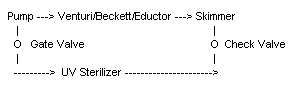
It depends on where the UV is at. Mine is above the sump, so if I throttled it before the UV chamber, I would starve the UV for water.

The Hartford loop is only used to maintain the water level in the skimmer, nothing else: water exits the bottom of the contact chamber into the hartford loop, has to travel up one leg of the loop and down the other. The height of the loop sets the water level inside the skimmer.
 

liquid

Advanced Reefer
Rating - 0%
0   0   0
Ah gotcha. The only images I was finding was for hartford loops for boilers, which is where my confusion came in. :)

Shane
 

hillbilly

Advanced Reefer
Rating - 0%
0   0   0
Am I the only one who vaccums their sandbed
lightly during water changes? Just wondering,
because I've been doing this for years and have
not had dsb problems. It really helps keep the
bed cleaner.
 

Sponsor Reefs

We're a FREE website, and we exist because of hobbyists like YOU who help us run this community.

Click here to sponsor $10:


Top