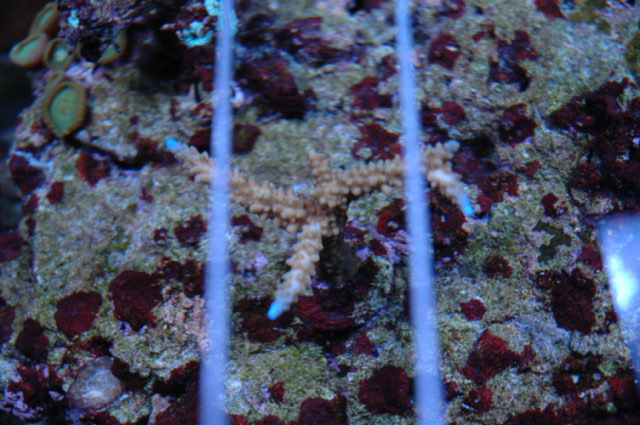
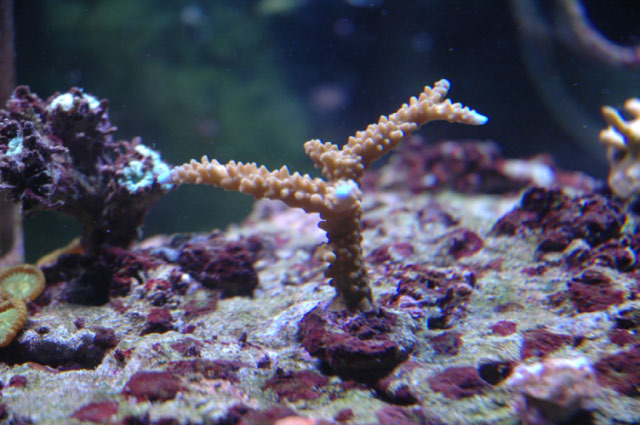
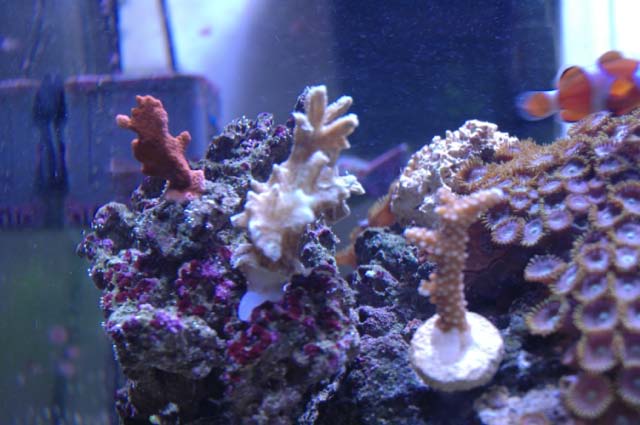
There is no way you can accurately tell what species your specimen may be based on that photo. Colour is also not a really reliable parameter, and depending on how long it has been in captive culture, you may or may not be able to use even the corallite or branch structure to ID it.
The problems with Acro ID are many fold and starts with the suppliers. Most have no clue what they are collecting and exporting and could care less. One of the few exceptions is RSVCoral.com located in Vanuatu, they are at least making an effort to accurately ID the corals they are propagating for the trade. Once the corals enter the wholesale and retail chain it is often impossible to know for sure where that coral was collected and they are often labelled with mostly useless common names. Then we get into frag swaps, were people are getting corals that may be 2nd, 3rd or 4th generation frags and have been grown under a variety of environments, all of which serve to alter the very characteristics that are essential to ID them correctly. To compound all of this further, corals can naturally hybridize in the wild so you can get intermediate forms.
Any coral taxonomist needs to know where a coral came from, and needs a fresh sample from the wild in order to make an ID with any level of confidence. Accurately IDing frags in captivity is more mysticism than reality I am afraid to say, IMO.
Finally, there is no form of tracking of corals in the trade. By this I mean, most people have no idea where their corals originated from. Contrast this with cats or dogs, where the pedigree's are well-document, for show animals at least. In the AZA, breeding programs for various animals are setup and again the lineage of all of them is well documented. We have none of that in the reef hobby, and it would be a pretty daunting task, but wouldn't be nice to know that that piece of Acropora you have is an offspring of colony X23878 collected ten years ago in Fiji and was originally identified as Acropora micropthalma, for example?
BTW, Acropora formosa is no longer a valid name and hasn't been for several years now, please try and use the correct name Acropora muricatum and spread the word!

Aloha!
JCD