



• Why not take a moment to introduce yourself to our members?

Kevin207

Experienced Reefer
Rating - 0%
0   0   0
I can save on the price of my tank if I order it by August 15th, hence the urgency. If they need to cut extra holes for circulation, I need to figure this out by the 15th 8O
So if you have a moment (or two)... :D

I would like to figure out the circulation options for a 9 foot tank given the setup & restrictions below, and then have it made.
Here is a rendering of the tank in the location it is to go:
http://www.reefs.org/phpBB2/viewtopic.php?p=1088828#1088828

I have seen holes cut into tanks for circulation on the internet and I was wondering if it would be good to somehow do this on the tank I have being made.

TANK SETUP & RESTRICTIONS:
-There will be two overflows: left back corner and right back corner.
-The right side of the tank will be hard up against the stone chimney on the right, so no VorTech through the glass option on the right
-The left side will have 4-6 inches of space on it, so a VorTech propeller would work on that side.
-The tank will be located such that you can see into it from both the front and back (not the sides at all though). From the back side you will be able to view about 6 feet of the tank. Therefore the reef in the middle 6 feet of the tank will be a bit lower (so you can see through the tank) and away from both the back and front of the tank.
-I will probably cover the overflows with live rock and corals, which means the left and right back corners with be covered with rock to the top of the water line

Given this last restriction, how should I get water behind the reef in the back corners? Just leave the rock away from the overflows just enough to put powerheads down there?

How are those Pentair Aquatics Customflo Water Systems? Should I consider using this somehow on the right side (no space on outside for VorTech remember) or just use a regular powerhead?

If I get the Customflo system should I get the bar with holes in it that will spray water over the top of the water line level (too noisy?) for surface turbulance?

How would I use holes cut for circulation to circulate water? Some kind of closed loop I am sure. I don't like putting more holes in a tank than I have to though.

Thanks for any and all input you all can offer.

I decided to separate this topic from another topic I set up called "Help me light a 9' tank" http://www.reefs.org/phpBB2/viewtopic.php?t=91381
 
A

Anonymous

Guest
Rating - 0%
0   0   0
Don't put powerheads in your tank. IMHO.

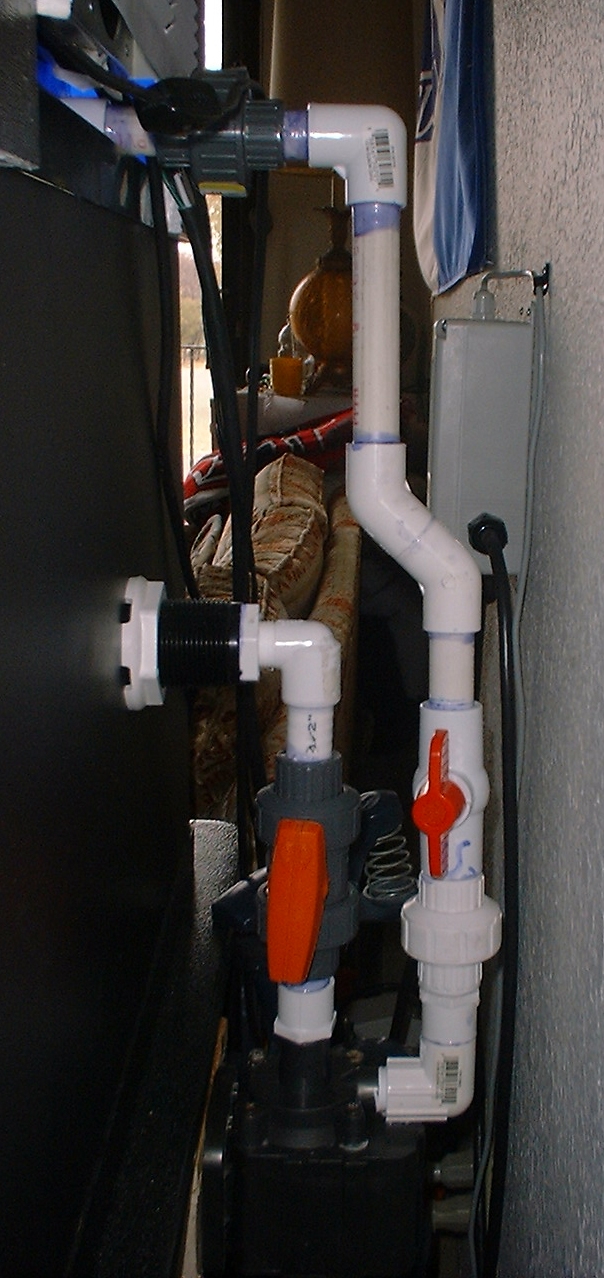
I say add several closed loops. This means cutting a hole in the glass somewhere, installing a bulkhead, and plumbing it to the intake of an external pump. The output of the pump is then plumbed to the reef however you like. Since your set up is in-wall I would plumb it up above and have it enter the tank from the top. You can conceal the plumbing by sticking it in the two front corners and having it point at your rockwork. You can have several outlets from each pump, and I would place large eductors on each. Then put some kind of decorative woodwork on your wall to cover up the last 3" or so of each side of the tank.
 
A

Anonymous

Guest
Rating - 0%
0   0   0
Here's an excellent example of a closed loop. I would have plumbed it a bit differently to minimize elbows (friction decreases efficiency of the pump) but the basic concept is all there. Note the ball valves and unions on each side of the pump to allow for removal and maintenance of the pump without draining your reef tank!
 

Attachments

  • closed loop plumbing.jpg
    closed loop plumbing.jpg
    475 KB · Views: 2,591

Kevin207

Experienced Reefer
Rating - 0%
0   0   0
Matt_Wandell":1nvft121 said:
Here's an excellent example of a closed loop.

Thanks a lot Matt.

Is the lower pipe an outlet from the tank, and the upper pipe going back in over the top of the water line?

Where is the best place to drain the water from? Up high so you can keep the outlet clear of algae and what not? Or is it better to somehow have it down near the bottom?
-Kevin
 
A

Anonymous

Guest
Rating - 0%
0   0   0
Looking at the picture it's hard to tell from the pump, but I would hazard a guess that the lower one is the "pump intake" part simply because if it was one over the top, it might have trouble restarting and get a kick of "air". Not to mention the exit above the tank usually leaves a bit more leeway to make a manifold or multiple outlets (drilling one hole in glass is a lot easier than drilling 2 or 3 or 4 :))

I've thought about doing what Matt said, only problems I see with that is 1) those centrifugal pumps that you use in a closed loop are way more energy hogs than a really nice effcieint pump (tunze or seio), and 2) Unless you get a really expensive and large one can't even compete with amount of water they can push... also if you go the educator route you need a pressure rated pump which also adds more electricity 'wasted'.. (although I'm not sure if someone has any studies on how much additional flow you get vs how much extra power the pump requires).
 
A

Anonymous

Guest
Rating - 0%
0   0   0
Kevin207":1huer083 said:
Matt_Wandell":1huer083 said:
Here's an excellent example of a closed loop.

Thanks a lot Matt.

Is the lower pipe an outlet from the tank, and the upper pipe going back in over the top of the water line?

Yes. Water exits the tank and enters the pump via the lower plumbing, and enters the tank and exits the pump via the higher plumbing.

Where is the best place to drain the water from? Up high so you can keep the outlet clear of algae and what not? Or is it better to somehow have it down near the bottom?
-Kevin

I prefer to place the intake inside the overflow. Hides the screen, and if you cover your overflow like me it won't get algae on it. If you do this, it is absolutely essential to create several anti-siphon holes on the return plumbing from the pump. Otherwise you can drain your entire tank into the overflow (and thus the sump) in a power outage.

You can stick the intake wherever is easy to access. IME it won't need to be cleaned more than once or twice a month.
 
A

Anonymous

Guest
Rating - 0%
0   0   0
sfsuphysics":2u8mradq said:
Looking at the picture it's hard to tell from the pump, but I would hazard a guess that the lower one is the "pump intake" part simply because if it was one over the top, it might have trouble restarting and get a kick of "air". Not to mention the exit above the tank usually leaves a bit more leeway to make a manifold or multiple outlets (drilling one hole in glass is a lot easier than drilling 2 or 3 or 4 :))

I've thought about doing what Matt said, only problems I see with that is 1) those centrifugal pumps that you use in a closed loop are way more energy hogs than a really nice effcieint pump (tunze or seio), and 2) Unless you get a really expensive and large one can't even compete with amount of water they can push... also if you go the educator route you need a pressure rated pump which also adds more electricity 'wasted'.. (although I'm not sure if someone has any studies on how much additional flow you get vs how much extra power the pump requires).

Tunzes/Ecotech Vortechs are certainly an option. I for one would never use them. I can't stand the look of a conspicuous powerhead in the tank. But they are great at producing water motion.
 
A

Anonymous

Guest
Rating - 0%
0   0   0
Exactly Matt, it's a matter of hiding something vs efficient flow. And even so with a few educators you're still going to have things jutting out of the tank, hiding them can only work so much too since you do want some flow in front of the rocks :)
 

Kevin207

Experienced Reefer
Rating - 0%
0   0   0
sfsuphysics":3hkpvp4a said:
since you do want some flow in front of the rocks :)
Do you want flow behind the rocks if you have them against the sides and or stacked up against the overflows?
 
A

Anonymous

Guest
Rating - 0%
0   0   0
Kevin207":5gatk5cm said:
sfsuphysics":5gatk5cm said:
since you do want some flow in front of the rocks :)
Do you want flow behind the rocks if you have them against the sides and or stacked up against the overflows?

Yes! An easy way to accomplish this would be with the example pictured above. Simply place an elbow facing straight down on that return and it will blow behind the rocks.
 
A

Anonymous

Guest
Rating - 0%
0   0   0
Well you do want flow behind the rocks but you also want it infront (well everywhere :)). My point was if you're using all the rocks to hide all the piping & educators then you're probably only getting flow behind the rocks atleast direct flow.
 

Minh Nguyen

Advanced Reefer
Rating - 0%
0   0   0
From personal experience, close loops add lots of heat into the tank (from the pump). Also intake of close loop need lots of protection for animals I keep anemones including H. magnifica). The stronger the cloose loop the bulkier the intake need to be.
You may want to consider surge tank. I think this is the most natural and least energy intensive (read cost in electircity and heat to the tank)
I recommended Tunzel or surge buckets. If you want to use close loop, I have a practically new electric 3 way flow valve that you may want to buy form me. I used it in my close loop befor to divert flow from one side to another. It cost me about 350 for this valve.
Two of the most problem free and great surge tanks (all easily DIY) are Carson and Bornerman surge tanks. You can easily find plans for them on the internet.
 
A

Anonymous

Guest
Rating - 0%
0   0   0
Minh Nguyen":31r2szrg said:
From personal experience, close loops add lots of heat into the tank (from the pump).

But don't they add far less heat than a submerged powerhead? :?

Also intake of close loop need lots of protection for animals I keep anemones including H. magnifica).

This is another good reason I place the intake in the overflow. :)

The stronger the cloose loop the bulkier the intake need to be.
You may want to consider surge tank. I think this is the most natural and least energy intensive (read cost in electircity and heat to the tank)
I recommended Tunzel or surge buckets. If you want to use close loop, I have a practically new electric 3 way flow valve that you may want to buy form me. I used it in my close loop befor to divert flow from one side to another. It cost me about 350 for this valve.
Two of the most problem free and great surge tanks (all easily DIY) are Carson and Bornerman surge tanks. You can easily find plans for them on the internet.

I vote Borneman style of the two. Far fewer bubbles. Surge tanks work amazingly well, but you somehow have to plumb a pump to them just the same. The biggest drawbacks are noise and salt creep from the spray which turn a lot of people off.
 

Kevin207

Experienced Reefer
Rating - 0%
0   0   0
Do you think that it would be possible to have the closed loop NOT cut into the tank by having it draw in from just below the water line with a vertical pipe coming out through the top and then having a surge tank or outlet pipe also coming in through the top of the tank? It may be difficult to prime the external pump, but maybe this could be a possible solution to avoid cutting the tank? You would just see a few inches of pipe sticking down into the tank just below the water line.

Borneman surge tank design sounds great, but I will have to weigh whether or not the slosh sound and salt creep are worth it.

I am getting closer to the end solution for this case, I can feel it :D
 

Minh Nguyen

Advanced Reefer
Rating - 0%
0   0   0
Intake of cloose loop need to be deep because if not it will suck in air and cause bubble in tank. Intake also cannot be inside the overflow box for the same reason. I had my intakes come down verticle at back corners of tank (two close loops) return come back through top of the tank., you don't have to drill your tank for close loop. Once the tank is primed, you don'e have re-prime it.
Surge bucket is essential for certain SPS and Anemone.
 

Kevin207

Experienced Reefer
Rating - 0%
0   0   0
Minh Nguyen":1tcnxwr8 said:
Intake of cloose loop need to be deep because if not it will suck in air and cause bubble in tank.
Makes complete sense. Maybe I can run my inlet pipes like you did but have a sweep or 90 toward the end so that I can get to them under just one piece of live rock to clean the intake.

Minh Nguyen":1tcnxwr8 said:
Surge bucket is essential for certain SPS and Anemone.
Right now I have no anemone, and few SPS corals (mostly LPS). However, I can see how a surge bucket system would work nicely for SPS and anemones.

Do you think I could use Sea Swirl products on my return line(s) to spread the current around? Here is their site:
http://www.sea-swirl.com/
Maybe they wouldn't replace a surge bucket but might be a decent runner up?
They seem like a nice solution, but I CAN'T SUBMERSE them....so closed loops will still have to end with either a surge bucket or a reducer of some sort.
 

Kevin207

Experienced Reefer
Rating - 0%
0   0   0
Minh Nguyen":3czvs1ce said:
Intake of cloose loop need to be deep because if not it will suck in air and cause bubble in tank.
Makes complete sense. Maybe I can run my inlet pipes like you did but have a sweep or 90 toward the end so that I can get to them under just one piece of live rock to clean the intake.

Minh Nguyen":3czvs1ce said:
Surge bucket is essential for certain SPS and Anemone.
Right now I have no anemone, and few SPS corals (mostly LPS). However, I can see how a surge bucket system would work nicely for SPS and anemones.

Do you think I could use Sea Swirl products on my return line(s) to spread the current around? Here is their site:
http://www.sea-swirl.com/
Maybe they wouldn't replace a surge bucket but might be a decent runner up?
They seem like a nice solution, but I CAN'T SUBMERSE them....so closed loops will still have to end with either a surge bucket or a reducer of some sort.
 
A

Anonymous

Guest
Rating - 0%
0   0   0
Also, you would be fine with Vortechs. They do not take up much space and would be easy to hide, plus, no heat/electricity in the tank.
 

Minh Nguyen

Advanced Reefer
Rating - 0%
0   0   0
Sea swirl is not problem free. They breakdown easy. My friend had two sea swirls, because multiple breakdown, he abandoned it (after about 2 years) and got two Tunze units instead. In a 9 foot tank, it will not be large at all. One on each end. It use minimal electricity (35-45 watts) and thus not put much heat into the tank. These units moves lots of water.
 

Sponsor Reefs

We're a FREE website, and we exist because of hobbyists like YOU who help us run this community.

Click here to sponsor $10:


Top