• Why not take a moment to introduce yourself to our members?

A

Anonymous

Guest
I haven't had a new fish in the main tank since my daughter was born. She is now 7, so to celebrate the move from 55 to (nominally) 100 gallons, I want to get two heniochus (the variety that don't chow down your reef).

Is two too many?

Two clowns and two tangs currently.

How can you be absolutely positively certain you get the reef-safe ones? What do the non-reef-safe ones eat?

I had one before in a FO tank. That was a quarter of a century ago. I recall it was fairly hardy.
 
A

Anonymous

Guest
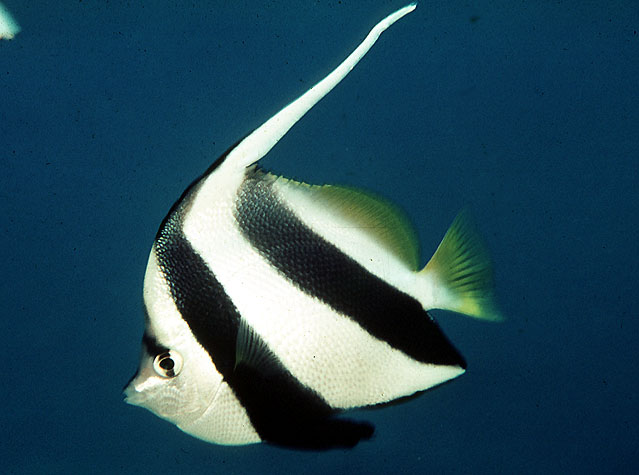
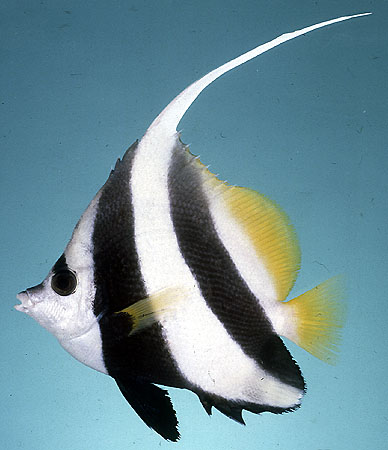
Great question. H. diphreutes is the "reef safe"* one. H. acuminatus is the non-"reef safe" one.

This is H. diphreutes (the reef safe one).
Hedip_u0.jpg


This is H. acuminatus (the NOT reef safe one that marinecenter lists as reef safe).
Heacu_u2.jpg


The most noticeable difference is around the forehead, snout, and breast. See it? In H. acuminatus, the profile of this area is more "pointed" for lack of a better term. In an exaggerated profile, H. diphreutes' head is shaped more like a "{", and H. acuminatus' head is shaped more like a "<".

This is no accident, of course. Somebody designed the head of H. acuminatus to fit inside tiny crevices for a reason. In the wild H. acuminatus feeds primarily on zooplankton, but it also feeds on things like coral polyps, zoanthids, bristleworms, and algae. You can see the logical extension of this design in such fish as the copper banded and long nosed butterflies as well. In reef aquariums, H. acuminatus tends to pick on hard and soft corals, tubeworms, etc. a bit more than its short snouted brutha.

H. diphreutes diet is entirely zooplanktivorous in the wild. In the reef aquarium, it looks at corals and desirable invertebrates, longs to feed on them, but simply doesn't know how. Most of the time. I have observed one specimen of H. diphreutes snack persistently on a colony of Protopalythoa polyps until it killed all of them, then move onto some zoanthids before it was removed. I suspect that either a) I mis-ID'd the fish, or b) all those fancy books that say it's a reef safe fish are wrong.

Having said all this, both fish are super hardy, easy to group, bold, and peaceful. Just feed them as often as possible.


*I hate the term "reef-safe". No one can agree on a concrete definition of course. Stonefish are "reef-safe" by some definitions. So I like to say "here's the things this fish may or may not eat", then you can decide whether you want those things in your tank or not.

Hope this helps.

Matt

PS. I like to type.

 
A

Anonymous

Guest
Thanks, Matt. That is exactly what I needed to know (and you probably remember me asking before in August or whenever that was).


The picture from the Marine Center makes it look more like the first one you have pictured. The head shape and the eye coloration.

4A0FC2961BA842FEAC7F736326DD09F4E.jpg


I wonder if they goofed on the ID?
 
A

Anonymous

Guest
Although the fin coloration looks like the second one.
 
A

Anonymous

Guest
Subcomandante Marcos":3jo4fyru said:
Thanks, Matt. That is exactly what I needed to know (and you probably remember me asking before in August or whenever that was).


The picture from the Marine Center makes it look more like the first one you have pictured. The head shape and the eye coloration.

4A0FC2961BA842FEAC7F736326DD09F4E.jpg


I wonder if they goofed on the ID?

They didn't goof on the ID. Those are H. acuminatus. They DID goof on the part where they say they are reef safe, however. Wrong fish.

The corner of the anal fin is another distinguishing characteristic between these two species, but in juveniles it's much less distinctive. In the adults pictured above it's pretty easy to see, but I find it less reliable for the size you'll probably be buying. The anal fin corner is more rounded in H. acuminatus, and sharp in H. diphreutes. Also, the second black band ends above the corner of the anal fin in H. acuminatus, and at the corner in H. diphreutes. This is really clear in the photos linked above. It's not so clear when you're looking at a tank full of fish that might have ripped or tucked in fins.
 
A

Anonymous

Guest
Oh yeah. Fin and eye coloration. I think you're just seeeing a flash reflection off the iris that makes it look silver. In normal lighting their eyes look about the same. Fin coloration might be a bit different but fish can get paler just from being stressed out. It'd be hard to distinguish the two this way.
 
A

Anonymous

Guest
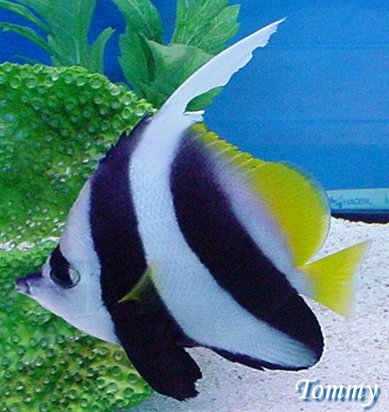
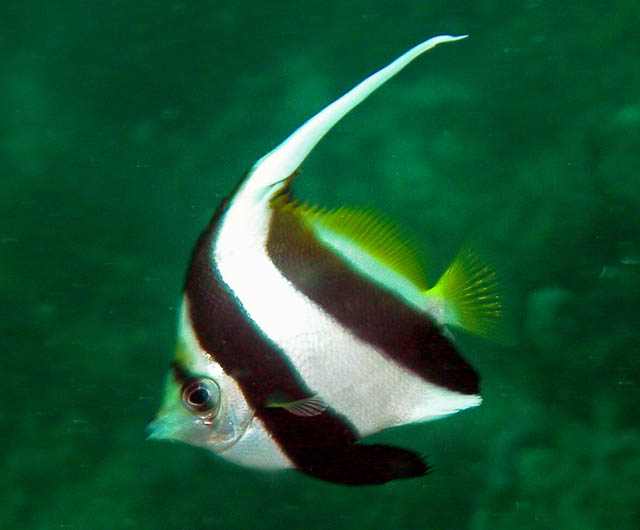
Okay, pop quiz. Which one's which?
 

Attachments

  • mystery3.jpg
    mystery3.jpg
    74 KB · Views: 1,635
  • mystery2.jpg
    mystery2.jpg
    81.1 KB · Views: 1,632
  • mysteryfish1.jpg
    mysteryfish1.jpg
    31.9 KB · Views: 1,634
A

Anonymous

Guest
2 and 3 are H. acuminatus. I think the first is not.
 
A

Anonymous

Guest
But if you told me 1 was H. acuminatus I would not be surprised.
 
A

Anonymous

Guest
Does H. acuminatus eat aiptasia?

If so, it would be worth it to keep it with inedible corals.
 
A

Anonymous

Guest
Subcomandante Marcos":1sv40h5k said:
Does H. acuminatus eat aiptasia?

If so, it would be worth it to keep it with inedible corals.

Great question! I don't know. I would bet yes.
 

SnowManSnow

Advanced Reefer
Rating - 0%
0   0   0
I noticed the eye is totally black on the second one.. and just a stripe on the first.. is that just fish by fish? or is that a distinguishing mark between the 2?

b
 
A

Anonymous

Guest
Rating - 0%
0   0   0
SnowManSnow":jc8fsbft said:
I noticed the eye is totally black on the second one.. and just a stripe on the first.. is that just fish by fish? or is that a distinguishing mark between the 2?

b

It's just the lighting. You're seeing the camera flash reflecting off the iris.
 
A

Anonymous

Guest
Rating - 0%
0   0   0
Matt_Wandell":vf2kofgs said:
Subcomandante Marcos":vf2kofgs said:
But if you told me 1 was H. acuminatus I would not be surprised.

You weren't wrong on #1.


I'm not following. For those viewers at home (and in the future), please tell me the correct answers for

1.

2.

3.
 
A

Anonymous

Guest
Rating - 0%
0   0   0
Subcomandante Marcos":1s6qk9vj said:
Matt_Wandell":1s6qk9vj said:
Subcomandante Marcos":1s6qk9vj said:
But if you told me 1 was H. acuminatus I would not be surprised.

You weren't wrong on #1.


I'm not following. For those viewers at home (and in the future), please tell me the correct answers for

1.

2.

3.

Sorry.

1. H. diphreutes
2. H. diphreutes
3. H. acuminatus.

2 is the only one I'd be confident IDing on the anal fin alone. I'd say the anal fins of 1 and 3 are inconclusive at best.
 
A

Anonymous

Guest
Rating - 0%
0   0   0
Actually, I vascilated on #1, so I get a 50%, which means no better than random guessing.


:. I can't tell them apart.
 

Sponsor Reefs

We're a FREE website, and we exist because of hobbyists like YOU who help us run this community.

Click here to sponsor $10:


Top