


Ok ,I have a 75 now going to a 90 Gal rr ..I will not be reusing my current live sand ..should I just clean it and try to sell it? I am still confussed about using my current live rock (it is infested with Bristles)I was thinking about getting Marcos rocks with some new Fiji rock (only like 20 lbs)Then starting the whole thing over from scratch ..The current water isnt even RO Its just Di. So I was gona reuse the old water but it seems like I would be just better off starting fresh?? I have 3 fish as of now and a few mushrooms in the tank and a few zoos I was going to put them in a 10 gallon for a few weeks..If I was to not reuse my current rock can I and should I sell it off or let it die then sell it??And suggestions on the rock ,sand and water ??Thanks Sal


You are using an out of date browser. It may not display this or other websites correctly.
You should upgrade or use an alternative browser.
You should upgrade or use an alternative browser.
Question about my new tank setup please help??
- Thread starter Malibu361
- Start date

Pedro Nuno Ferreira
Liquid Breathing
- Location
- Portugal - Vila Nova de Gaia
Hi Malibu361
From your writing you look in fact very confused. Bristle worms are part of the system inhabitants and from your description it seems you have an overwhelming swarm of them. Now one of the reasons for having so many of such worms, if I well understood your description, its because there is a lot o food for them, like detritus, so in that event the live sand you have could possibly have become a mudflat in which case it might perhaps be best to use only some of it to inoculate the new sand you may be using in the new tank, but this said I had to see how in fact it looks to be more sure of that possibility, still and not having seen/evaluate it I would be inclined to at least use some of it to inoculate the new sand bed, especially if yo are planning to use a Deep Sand Bed.
About using the live rock you have, I think (and please correct me if I'm mistaken) that KathyC already gave you a good suggestion which is, to "clean" the live rock in your old tank water and profit to get rid of some of the Bristle worms, and use it afterwards in the new tank.
About the old water, simply get rid of it once you used it to "clean" the Live Rock and use new water made from RO and a good salt mix or NSW...which ever is better for you.
Please consider also to read the following if by any chance you haven't done so already, as it will clarify some "myths" about:
Annelids (Bristle worms - By Ronald L. Shimek)
Deep Sand Beds - By Ronald L. Shimek
I hope this helps you to understand and decide what is the best way for you. Look forward to read more from you about this.
Cheers
Pedro Nuno ;-)
Post Scriptum: Please do not forget to use surgical gloves or similar when dealing with the Live Rock and/or the Bristle worms for the obvious reasons mentioned in Ron Shimek's article about them that I placed above.
From your writing you look in fact very confused. Bristle worms are part of the system inhabitants and from your description it seems you have an overwhelming swarm of them. Now one of the reasons for having so many of such worms, if I well understood your description, its because there is a lot o food for them, like detritus, so in that event the live sand you have could possibly have become a mudflat in which case it might perhaps be best to use only some of it to inoculate the new sand you may be using in the new tank, but this said I had to see how in fact it looks to be more sure of that possibility, still and not having seen/evaluate it I would be inclined to at least use some of it to inoculate the new sand bed, especially if yo are planning to use a Deep Sand Bed.
About using the live rock you have, I think (and please correct me if I'm mistaken) that KathyC already gave you a good suggestion which is, to "clean" the live rock in your old tank water and profit to get rid of some of the Bristle worms, and use it afterwards in the new tank.
About the old water, simply get rid of it once you used it to "clean" the Live Rock and use new water made from RO and a good salt mix or NSW...which ever is better for you.
Please consider also to read the following if by any chance you haven't done so already, as it will clarify some "myths" about:
Annelids (Bristle worms - By Ronald L. Shimek)
Deep Sand Beds - By Ronald L. Shimek
I hope this helps you to understand and decide what is the best way for you. Look forward to read more from you about this.
Cheers
Pedro Nuno ;-)
Post Scriptum: Please do not forget to use surgical gloves or similar when dealing with the Live Rock and/or the Bristle worms for the obvious reasons mentioned in Ron Shimek's article about them that I placed above.
Last edited:



- Location
- Melville, NY
Hey Pedro -
That article about deep sand beds was a good read. But I was curious. The author says to never add sand sifting gobies or stars to your tank because they thrive on the beneficial "sand critters" that our tanks need to thrive. What is your take on that? Are they really that detrimental to the sand bed and overall quality of the tank?
That article about deep sand beds was a good read. But I was curious. The author says to never add sand sifting gobies or stars to your tank because they thrive on the beneficial "sand critters" that our tanks need to thrive. What is your take on that? Are they really that detrimental to the sand bed and overall quality of the tank?
Pedro Nuno Ferreira
Liquid Breathing
- Location
- Portugal - Vila Nova de Gaia
Hey Pedro -
That article about deep sand beds was a good read. But I was curious. The author says to never add sand sifting gobies or stars to your tank because they thrive on the beneficial "sand critters" that our tanks need to thrive. What is your take on that? Are they really that detrimental to the sand bed and overall quality of the tank?
Hi MikeyZO
Yes they are really detrimental as I could experience, and so can be for example pipe fish which in my case were detrimental to the swimming fauna I have. Once the pipe fish were removed the swimming fauna recovered. So in the refugium I only have Chaetomorpha algae, some Stomatella snails and Euplica snails and the water motion is very slow and overflows to the sump by zero edge dripping. Denitrification environments are slow water movement zones. ellebelle has a good example of denitrification process taking place in Her tank. In the photographs of Her beautiful tank below
the bubbles visible in the coral gravel against the glass, are of N2 (Nitrogen) resulting from the complete nitrogen cycle which releases gaseous nitrogen, this means that the water flows slowly through the sand bed of Her tank and the sand bed has enough hight and adequate granulometry to allow the establishing of the anaerobic conditions and related bacteria and organisms that perform the Denitrification, so basically ellebelle can sit back and relax because She has the complete infauna set of the "clean-up crew" and the "reef-janitorial" staff working for Her....:Blurp::tongue1::wineglass:flower: ...well She still has to perform water changes and other tank maintenance because the infauna has to be taken care of like the other animals living in Her system, but this is done in far better biological and healthier conditions. Also I don't know if She has sand sifting organisms and might have them, in which case they are possibly not over imposing their deleterious action as they might be in reduced numbers or to weak to cause an impact, still if this balance shifts, the sand bed critters would suffer as would the denitrification process, etc...ellebelle said: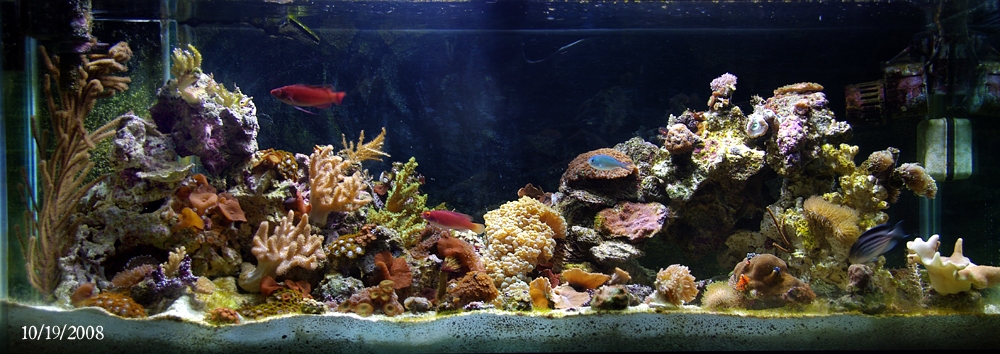
New FTS now that everything has settled in a little.
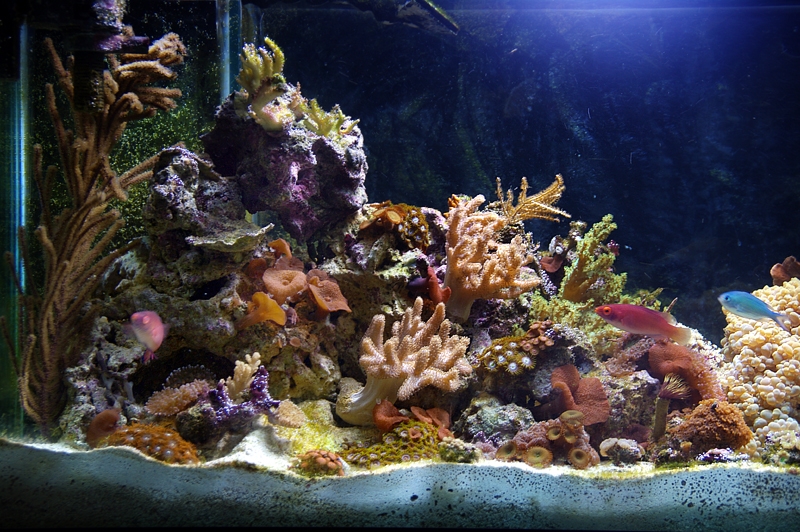
close up of the left side
Its beautiful to see a Deep Sand Bed maturing, all those busy little, and some of them strange looking, critters moving all around...another excellent addition to a refugium with a deep sand bed, is Stomatella snails
The build up of a Deep Sand Bed is a work of patience and calm as it takes time to work and set itself. Most of the failures are caused by hasty preparation or lack of understanding on how it works or over expectation about the possibilities of a deep sand bed, which lead to mudflats, clogging, and all kinds of problems issuing from that.
Cheers
Pedro Nuno ;-)
Last edited:
- Location
- Melville, NY
you mentioned pipefish also being harmful to the swimming fauna... I take it that may also include dragonets such as the mandarins and scooter blennys as their chief source of nourishment are pods?
Pedro Nuno Ferreira
Liquid Breathing
- Location
- Portugal - Vila Nova de Gaia
you mentioned pipefish also being harmful to the swimming fauna... I take it that may also include dragonets such as the mandarins and scooter blennys as their chief source of nourishment are pods?
Hi MikeZO
Yes you could say that if the objective is to have that fauna left alone or if the fauna in question is insufficient to sustain the animals, which was my case as the refugium is to small to "produce" the quantity needed to nourish such fish and keep the balance...and I underline Balance because thats what nature does, establishing balanced predator prey relations, so when the balance is broken, you have problems and this goes also for the sand sifting critters as their food needs are so large that they may unbalance the whole thing...however if you have resources you may provide a large enough system where both can live in balance, which in most cases of our home closed systems is not feasible. Take for instance a Strombus snail...I have one...and only one! in a 180g tank, otherwise it might not have enough to eat and unbalance the relation between predator and prey or available food source and animal...
Another example...this weekend I will probably exchange two large tangs I have for corals, as they grew so much that not only they are not comfortable in the 180g tank, as their biological load and food needs are simply to much for the system and the two deltec skimmers apf600, the deep sand bed I have can't cope with it properly. This happened because I intended them for a 1000g tank that hasn't seen the light of day simply because I want to buy a new house and don't want to have such a large tank on hands to move, so bad planning on my part.:irked::grumpy:..I also make mistakes you know...is part of being human:Blurp:
Cheers
Pedro Nuno ;-)




- Location
- 11756
Malibu,
If you wash out the old live sand its going to die off, basically becoming dead sand. Depending on how thoroughly you wash it, it will be clean enough to use given you dont have any inhabitants in the tank for a few days to let the mini cycle occur. I used old sand in my tank back in january after washing it out to the point where it clouded my water very little.
As for selling it after you wash it, i don't think its a good idea. Most folks end up giving it away or dumping it cause of the work involved in getting it to a state ready for a new tank.
If you wash out the old live sand its going to die off, basically becoming dead sand. Depending on how thoroughly you wash it, it will be clean enough to use given you dont have any inhabitants in the tank for a few days to let the mini cycle occur. I used old sand in my tank back in january after washing it out to the point where it clouded my water very little.
As for selling it after you wash it, i don't think its a good idea. Most folks end up giving it away or dumping it cause of the work involved in getting it to a state ready for a new tank.

- Location
- Manhattan, New York
Just to add one small point - you can only sell live/dead/washed sand is there's a demand for it.
I don't think there's a demand for it, and most of the people on the forum give it away for free anyway. So may not be worth the hassle after all.
I don't think there's a demand for it, and most of the people on the forum give it away for free anyway. So may not be worth the hassle after all.
Well whatever the case may be sell give I dont care either way I just dont want to throw it away I feel that is a big waste and I would much rather reuse it ..But I will be kinda pressed for time with setting up the new tank and waiting to wash my old sand then a mini cycle etc..I dont really know if my live rock will stay alive that long ina garbage pail along with my 3 fish and snails and crabs..so all said and done I guess I will just buy sand it sounds like it will be the quickest solution ..and Pedro how much of my sand should I use to seed my new"dead" sand? As my current sand bed looks exaclty as the one in the article you had sent ..so I guess thats a good thing..Thanks again Sal
Pedro Nuno Ferreira
Liquid Breathing
- Location
- Portugal - Vila Nova de Gaia
Well whatever the case may be sell give I dont care either way I just dont want to throw it away I feel that is a big waste and I would much rather reuse it ..But I will be kinda pressed for time with setting up the new tank and waiting to wash my old sand then a mini cycle etc..I dont really know if my live rock will stay alive that long ina garbage pail along with my 3 fish and snails and crabs..so all said and done I guess I will just buy sand it sounds like it will be the quickest solution ..and Pedro how much of my sand should I use to seed my new"dead" sand? As my current sand bed looks exaclty as the one in the article you had sent ..so I guess thats a good thing..Thanks again Sal
Hi ;-)
The way I see it based on experience and without having seen/evaluate your sand bed:scratchch, you have to possibilities:
a) Mix 30% of your live sand with the new sand and distribute the remaining 70% by other members who like this will renew/reinforce their own infauna in their sand beds or deep sand beds.
b) Use the majority, say some 70% of your live sand bed that you "clean" lightly with the old water of your 75g tank, in you new 90g tank to which you add enough quantity of new sand to complete the quantity increase needed between a 75g and a 90g tank.
Again I did not see/evaluate your sand bed, still be that it as it is, I would probably go for the b):approve: possibility, even if with 50% quantity because the biological value of a live sand is very high and very important. The main thing here to avoid are dead spots and you can detect them to some extent by probing the sand bed with a small stick or something similar. The places were the stick gets stuck, like if it were clay or plasticine or simply to hard to let the stick in, those are to be removed and disposed of as they are probably mudflats or sediment clumps completely anoxic. This is not a linear thing I can explain, but this is the best way I can do it now. I hope it helps you.
Again and although you mentioned that your sand bed is similar to the one Ron Shimek shows in His article and the fact that it is not the same thing as seeing/evaluating it in person, could you please put some photographs of it here...at least it gives an idea and could help further to help you.
Cheers
Pedro Nuno ;-)
Sponsor Reefs
We're a FREE website, and we exist because of hobbyists like YOU who help us run this community.
Click here to sponsor $10: