• Why not take a moment to introduce yourself to our members?

Pinkheine

No More Room :-(
Rating - 100%
18   0   0
What do you do?

RO/DI water used for top off. Do you buffer the PH? Or just add the top off?

Anyone have any links on the subject? I have found conflicting views on whether or not to buffer or not. Just wondered what everyone does. Some of what I read states that people battle low alk and in turn PH because of adding unbuffered top off water. Any truth in that?

Our water changes add the nutrients needed currently but we have been having a larger than normal PH swing from night and day lately and think we may either have to start dosing with or buffer the top off water. Not really sure. Just trying to gain more information on the subject. TIA.
 

JLAudio

Advanced Reefer
Location
Flushing
Rating - 100%
28   0   0
The only time I buffer my water is when I would do Freshwater dips (controversial, but sick of Tangs with ich), but besides that never even thought about it, but interesting topic and curious about the consensus
 

D1J8Z

Advanced Reefer
Location
oceanside, NY
Rating - 100%
74   0   0
Always buff the water!


What do you do?

RO/DI water used for top off. Do you buffer the PH? Or just add the top off?

Anyone have any links on the subject? I have found conflicting views on whether or not to buffer or not. Just wondered what everyone does. Some of what I read states that people battle low alk and in turn PH because of adding unbuffered top off water. Any truth in that?

Our water changes add the nutrients needed currently but we have been having a larger than normal PH swing from night and day lately and think we may either have to start dosing with or buffer the top off water. Not really sure. Just trying to gain more information on the subject. TIA.
 

Pedro Nuno Ferreira

Liquid Breathing
Rating - 0%
0   0   0
What do you do?

RO/DI water used for top off. Do you buffer the PH? Or just add the top off?

Hi Pinkheine
I use it according to the needs but always to top off. I use it most often to add kalkwasser. If no need of Kalkwasser then I use it just to top off. If I need to buffer, then I use it to do that...I use it according to the needs of the system.

Pinkheine...if buffering needs to be done, then it is done, if not, then just top off, or you can use it to add Kalkwasser as I do. Basically we have to top off and according to the needs of the moment we may simply top off with RO water or then if needed I can use to put Kalkwasser or to buffer the pH.
To buffer every day, could end up causing severe variations at one or another moment. Things have to be done according to the needs of the system and in some cases, not simultaneously or one will interfere with the other. From your description it seems you have something not working well in your system to cause those variations so one has to find out what could be causing those variations.

Pinkheine said:
Anyone have any links on the subject? I have found conflicting views on whether or not to buffer or not. Just wondered what everyone does. Some of what I read states that people battle low alk and in turn PH because of adding unbuffered top off water. Any truth in that?

I don't know if you came across the following in you searches, still I suggest you to see the following
Understandng Calcium and Alkalinity
High pH causes and cures
Low pH causes and cures

If people battle low alk and in turn pH due to the adding of unbuffered top off water, then possibly the the RO water is not exactly RO water and possibly its pH is rather acid???!!!???

Pinkheine said:
Our water changes add the nutrients needed currently but we have been having a larger than normal PH swing from night and day lately and think we may either have to start dosing with or buffer the top off water. Not really sure. Just trying to gain more information on the subject. TIA.

Please read the articles I suggested or if you already have, lets us know if you find anything that you feel could be a cause of what is happening with your system.

we look forward to read more form you about this for possible further help.

Cheers
Pedro Nuno ;-)
 

mray

?
Location
Queens
Rating - 99%
96   1   0
I don't believe your top-off water is the cause for your larger pH swings. Pure water may be slightly acidic because carbon dioxide has dissolved in it.

Are your windows closed more often now because of the cold weather? Carbon dioxide can build up and cause a larger swing at night but it isn't damaging at all.
 

Pinkheine

No More Room :-(
Rating - 100%
18   0   0
Our PH swing is from 7.9 to 8.3. It doesn't seem to climb back up until nearly the end of the light cycle during the day. All other parameters are in normal range.

To be honest I never really paid much attention to the PH daily, as I should have been all along, up until we had several new fish losses lately. Could be they are totally unrelated, maybe not. IDK. All I know is that the PH doesn't seem stable and that seems like an awfully big swing. None of the corals or established fish seem to be effected by it, but it just seems like a lot. I was wondering if overtime from adding non buffered top off water if that was an issue.

Yes I have buffered the tank, still it has the same swing. Even when the alk is good and the mag is good as well. I'm lucky on a day that it actually does reach back up to 8.3. Even with buffering the PH doesn't hold.

Could this be that our tank may be using more nutrients than it did in the beginning that we would have to dose weekly? IDK weekly water changes used to hold everything at the correct levels. I slacked and was a lazy reefer for a few months (adding salt water for the skimmer pull out and regular RO/DI for top off) but no water changes. Everything grew like crazy but now that I am back on top of things and testing regularly again.. things just aren't up to par. I'm open to suggestions and or another experienced reefer to stop by, take a look, test or whatever.

Just wondered if anyone else buffered top off water or not and what their results were overtime etc. and if it really makes that much of a difference.
 

Pedro Nuno Ferreira

Liquid Breathing
Rating - 0%
0   0   0
This is a simple case of occam's razor

Entia non sunt multiplicanda praeter necessitatem

Lex parsimoniae .... ;-)

Translation: entities must not be multiplied beyond necessity

"Pluralitas non est ponenda sine necessitate" translation - plurality should not be posited without necessity

so basically the explanation of any phenomenon should make as few assumptions as possible, eliminating those that make no difference in the observable predictions of the explanatory hypotesis or theory...heuristic maxim or rule of the thumb

;-) well thats a good approach and I for one like to keep things simple, still many of this is not linear and there may be many variables that can produce a same result...we are not there (I'm not) and one has to be sure that in fact its that and not another thing disturbing the system. From Pinkheine's description it could be that in fact, but I dealt with a similar case and the thread went on until finally the person remembered a "small" incident to which it did not pay much attention, but that turned out to be the cause of the all thing;-)

I don't know if Pinkheine found anything from the links I gave as they might help to find causes or provide clues for causes.

Cheers
Pedro Nuno ;-)
 

Pinkheine

No More Room :-(
Rating - 100%
18   0   0
I guess my question is a mute point. Seems as if there is no explanation for the Ph swings and the Ph not climbing back up as rapidly as everyone seems to say theirs does.

The top off water will be buffered before going into the tank because I add a few gallons when I top off sometimes less. But typically it is a gallon or so.

Weekly water changes have again commenced and I will monitor things and see what happens. Either we have to start dosing the tank now or we don't. That still remains to be seen. Have to get back into a regular routine again before I can gauge anything anyways. So for now... I'll test daily or once every other day. Monitor my results and continue with weekly water changes.

The fish losses were what I think and two others think are attributed to parasites. The established fish were not effected only newly introduced fish. Then again it could be the Ph. IDK. Will just have to wait it out then try a new fish in a month or so.
 

Pedro Nuno Ferreira

Liquid Breathing
Rating - 0%
0   0   0
Hi Pinkheine

this could be the cause for those pH swings

Randy Holmes-Farley said:
Carbon Dioxide and pH........

This process is happening continuously in reef aquaria, and it tends to reduce the pH due to the carbon dioxide produced.
The net effect of these processes is that pH rises during the day and drops at night in most reef aquaria. This change varies from less than a tenth of a pH unit, to more than 0.5 pH units in typical aquaria. Complete aeration of the aquarium water will prevent the diurnal pH swing entirely, by driving out any excess carbon dioxide or absorbing excess carbon dioxide when deficient. In practice this goal is not often attained, and the pH does change between day and night.
Consequently, the pH will nearly always be highest at the end of the light cycle. The only time that this is not the case is when there are timed additions of other things that impact pH (e.g., limewater, other alkalinity additions, and even the entry of carbon dioxide from the room air, in which the level of carbon dioxide may vary as human activities around the aquarium change throughout the day). The diurnal pH swing alone is not typically strong enough to drive the pH of reef aquaria to excessive levels (i.e., pH > 8.5). If it does, the aeration is clearly inadequate, and more aeration will likely solve the problem.
The more common way for reef aquaria to attain excessive pH is through high pH additives, most notably the use of alkalinity additives that contain hydroxide (limewater) or carbonate (some two part additives, for example). Figure 3 shows how the pH and alkalinity change as limewater is added to a reef aquarium. The limewater converts some of the carbonic acid into bicarbonate, effectively making the water deficient in carbon dioxide (H[SIZE=-1]2[/SIZE]CO[FONT=Arial, Helvetica, sans-serif][SIZE=-2]3[/SIZE][/FONT]) until the aquarium can absorb more carbon dioxide from the air to replace the lost carbonic acid:

Randy Holmes-Farley said:
This process is happening all of the time in reef aquaria, and it tends to reduce the pH due to the carbon dioxide produced.
The net effect of these processes is that pH rises during the day and drops at night in most reef aquaria. This change varies from less than a tenth of a pH unit, to more than 0.5 pH units in typical aquaria. As is discussed in other parts of this article, complete aeration of the aquarium water to drive out excess carbon dioxide, or pull in excess carbon dioxide when deficient, will prevent the diurnal ph swing entirely. In practice that is often not attained, and there is a pH change between day and night.
In addition to aeration, the amount of chemical buffering in the water will impact the magnitude of the pH swing. Higher carbonate alkalinity leads to a smaller pH swing as the combination of carbonate and bicarbonate buffer against pH changes. Boric acid and borate also buffer against pH changes. Both of these buffer systems have more capacity at high pH (8.5) than at low pH (7.8), so aquarists with lower pH may see a larger pH swing for that reason alone. I have detailed all of these buffering effects and concerns about the diurnal pH swing in a previous article.

Randy Holmes-Farley said:
Carbon Dioxide and pH
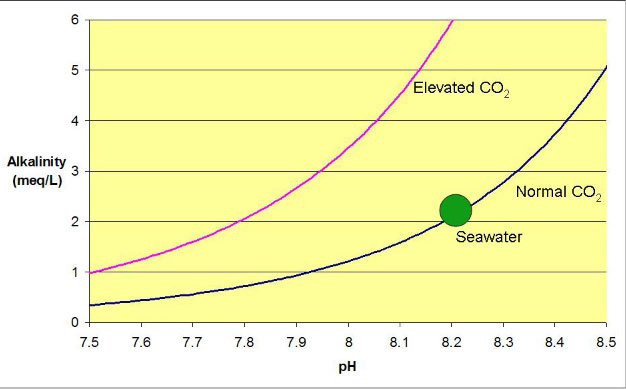
The pH of marine aquarium water is intimately tied to the amount of carbon dioxide dissolved in the water. It is also tied to the alkalinity. In fact, if water is fully aerated (that is, it is in full equilibrium with normal air) then the pH is exactly determined by the carbonate alkalinity The higher the alkalinity, the higher the pH. Figure 1 shows this relationship for seawater equilibrated with normal air (350 ppm carbon dioxide), and equilibrated with air having extra carbon dioxide as might be present in a home (1000 ppm). Clearly, the pH is lower at any given alkalinity when the carbon dioxide is raised. It is this excess carbon dioxide that leads to most low pH problems for reef aquarists.
Figure1.jpg
Figure 1. The relationship between alkalinity and pH for seawater equilibrated with air containing normal and elevated carbon dioxide levels. The green dot shows natural seawater equilibrated with normal air, and the curves reflect the result that would be obtained if the alkalinity were artificially raised or lowered.​
A simple way to think of this relationship is as follows. Carbon dioxide in the air is present as CO[SIZE=-1]2[/SIZE]. When it dissolves into water, it becomes carbonic acid, H[SIZE=-1]2[/SIZE]CO[SIZE=-1]3[/SIZE]:

  1. 3. CO2 + H2O ? H2CO3
The amount of H[SIZE=-1]2[/SIZE]CO[SIZE=-1]3[/SIZE] in the water (when fully aerated) is not dependent on pH, but only on the amount of carbon dioxide in the air (and somewhat on other factors, such as temperature and salinity). For systems not at equilibrium with the air around them, which includes many reef aquaria, the aquarium can be thought of "as if" it were in equilibrium with a certain amount of CO[SIZE=-1]2[/SIZE] in the air, which is effectively defined by the amount of H[SIZE=-1]2[/SIZE]CO[SIZE=-1]3[/SIZE] in the water. Consequently, if an aquarium (or the air it is being equilibrated with) has "excess CO[SIZE=-1]2[/SIZE]" in it, that means that it has excess H[SIZE=-1]2[/SIZE]CO[SIZE=-1]3[/SIZE]. This excess H[SIZE=-1]2[/SIZE]CO[SIZE=-1]3[/SIZE], in turn, means the pH will fall, as shown below.
Seawater contains a mixture of carbonic acid, bicarbonate, and carbonate that are always in equilibrium with each other:

  1. 4. H2CO3 ?? H+ + HCO3- ?? 2H+ + CO3--
Equation 4 shows that if an aquarium has excess H[SIZE=-1]2[/SIZE]CO[SIZE=-1]3[/SIZE], some if it dissociates (breaks apart) into more H[SIZE=-1]+[/SIZE], HCO[SIZE=-1]3[/SIZE][SIZE=-1]-[/SIZE], and CO[SIZE=-1]3[/SIZE][SIZE=-1]--[/SIZE]. Consequently, because of this extra H[SIZE=-1]+[/SIZE], the pH will be lower than if there were less CO[SIZE=-1]2[/SIZE]/H[SIZE=-1]2[/SIZE]CO[SIZE=-1]3[/SIZE] in it. If seawater has a huge excess of CO[SIZE=-1]2[/SIZE], the pH can be as low as pH 4-6. Equilibrating my aquarium water with carbon dioxide at 1 atmosphere resulted in a pH of 5.0, although that low a value would be unlikely to be attained in a reef aquarium as the substrate and coral skeletons would buffer it as they dissolved. My aquarium water in equilibrium with 1 atmosphere of carbon dioxide and excess solid aragonite (a crystalline form of calcium carbonate that is the same form present in coral skeletons) resulted in a pH of 5.8.
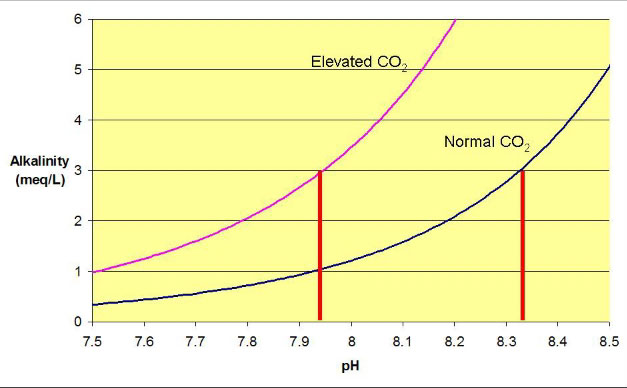
Figures 2-5 show graphically some of the ways of raising pH in aquaria. For example, if the aquarium has an alkalinity of 3 meq/L (8.4 dKH) and has a pH of 7.93, then the aquarium must have excess CO[SIZE=-1]2[/SIZE] in it (or else the pH would be just over 8.3). Ways to raise pH include:

  • Aerating the water with "normal air," driving out the excess carbon dioxide, will move the aquarium parameters along the green line of Figure 3, raising pH to just over pH 8.3. This effect is also what would happen if the growth of macroalgae were used to absorb some of the excess carbon dioxide, although it is rare for that effect to be able to move it all the way along the green line to above pH 8.3.
  • Raising the alkalinity, even if it still has the "excess CO[SIZE=-1]2[/SIZE]" in it, will raise pH by moving the aquarium parameters along the green line in Figure 4, to a pH of about 8.1 at an alkalinity of 4.5 meq/L (12.6 dKH).
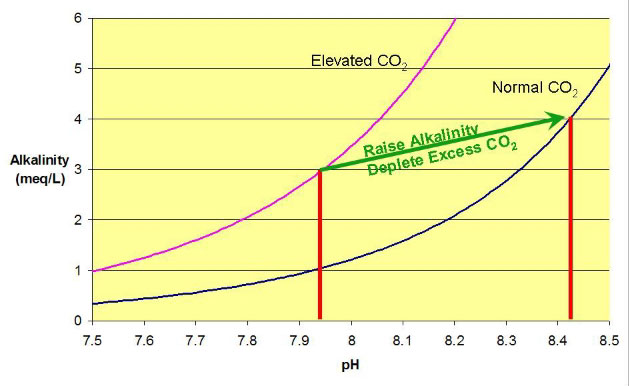
  • Using limewater (kalkwasser) to deplete the excess CO[SIZE=-1]2[/SIZE] (to normal levels), and also to raise the alkalinity (to 4 meq/L) could move the curve along the green line in Figure 5, resulting in a pH over 8.4 and an alkalinity of 4 meq/L (11.2 dKH).
Figure2.jpg
Figure 2. The same curves as in Figure 1, with red bars showing the pH that results at an alkalinity of 3 meq/L (8.4 dKH). The pH is clearly much higher at normal carbon dioxide levels than with elevated carbon dioxide.​

Figure3.jpg
Figure 3. The same curves as in Figure 1 showing the effect of aeration on pH when starting with excess carbon dioxide.​

Figure4.jpg
Figure 4. The same curves as in Figure 1 showing the effect of increased alkalinity on pH when leaving the excess carbon dioxide unchanged.​

Figure5.jpg
Figure 5. The same curves as in Figure 1 showing the effect of limewater (kalkwasser) on pH by both reducing the excess carbon dioxide (the hydroxide combines with it to form bicarbonate and carbonate) and increasing the alkalinity.​
Why Does pH Change During the Day and Night?
The diurnal (daily) change in pH in reef aquaria comes about because of the biological processes of photosynthesis and respiration. Photosynthesis is the process whereby organisms convert carbon dioxide and water to carbohydrate and oxygen. The net reaction is:

  1. 5. 6CO2 + 6H2O + light ? C6H12O6 (carbohydrate) + 6O2
So there is net consumption of carbon dioxide during the day. This net consumption leads to many aquaria becoming deficient in CO[SIZE=-1]2[/SIZE] during the day, and the pH rises.
Likewise, organisms also carry out the process of respiration, where this carbohydrate is converted back into energy for other processes. In the net sense, it is the opposite of photosynthesis:

  1. 6. C6H12O6 (carbohydrate) + 6O2 ? 6CO2 + 6H2O + energy
This process is happening all of the time in reef aquaria, and it tends to reduce the pH due to the carbon dioxide produced.
The net effect of these processes is that pH rises during the day and drops at night in most reef aquaria. This change varies from less than a tenth of a pH unit, to more than 0.5 pH units in typical aquaria. As is discussed in other parts of this article, complete aeration of the aquarium water to drive out excess carbon dioxide, or pull in excess carbon dioxide when deficient, will prevent the diurnal ph swing entirely. In practice that is often not attained, and there is a pH change between day and night.
In addition to aeration, the amount of chemical buffering in the water will impact the magnitude of the pH swing. Higher carbonate alkalinity leads to a smaller pH swing as the combination of carbonate and bicarbonate buffer against pH changes. Boric acid and borate also buffer against pH changes. Both of these buffer systems have more capacity at high pH (8.5) than at low pH (7.8), so aquarists with lower pH may see a larger pH swing for that reason alone. I have detailed all of these buffering effects and concerns about the diurnal pH swing in a previous article.

Randy Holmes-Farley said:
Carbon Dioxide and pH
The pH of marine aquarium water is intimately tied to the amount of carbon dioxide dissolved in the water and to its alkalinity. In fact, if water is fully aerated (that is, it is in full equilibrium with normal air), then the pH is exactly determined by the carbonate alkalinity. The higher the alkalinity, the higher the pH. There is, in fact, a simple mathematical relationship between alkalinity, pH, and carbon dioxide that I have discussed previously. Figure 2 shows this relationship graphically for seawater equilibrated with normal air (350 ppm carbon dioxide), and equilibrated with air having extra carbon dioxide as might be present in certain homes (1000 ppm). Figure 2 also shows the pH/alkalinity relationship in water that is deficient in carbon dioxide. Nearly all high pH situations encountered in reef aquaria are caused by a carbon dioxide deficiency.
Only rarely would excessively high pH be caused by high alkalinity alone, because in order for the pH to rise above pH 8.5 with a "normal" amount of carbon dioxide present, the alkalinity would have to be above 5 meq/L (Figure 2). At these high levels of both pH and alkalinity, calcium carbonate would very likely begin to precipitate abiotically, and such precipitation itself reduces pH and alkalinity. So if such a situation arose, it would not typically last long on its own in a reef aquarium.
Figure 2. The relationship between alkalinity and pH for seawater with normal carbon dioxide
levels (black), excess carbon dioxide (purple) or deficient carbon dioxide (blue). The green
area represents normal seawater.​
Detailed Chemistry of CO[SIZE=-1]2[/SIZE] in Seawater
A simple way to think of the relationship between carbon dioxide and pH is as follows. Carbon dioxide in the air is present as CO[SIZE=-1]2[/SIZE]. When it dissolves into water, it becomes carbonic acid, H[SIZE=-1]2[/SIZE]CO[FONT=Arial, Helvetica, sans-serif][SIZE=-2]3[/SIZE][/FONT]:
1. CO2 + H2O ? H2CO[FONT=Arial, Helvetica, sans-serif][SIZE=-1]3[/SIZE][/FONT]
The amount of H[SIZE=-1]2[/SIZE]CO[FONT=Arial, Helvetica, sans-serif][SIZE=-2]3[/SIZE][/FONT] in the water (when fully aerated) is dependent not on pH, but only on the amount of carbon dioxide in the air (and somewhat on other factors, such as temperature and salinity). Systems not at equilibrium with the air around them, which includes many reef aquaria, may have too much or too little CO[SIZE=-1]2[/SIZE] in them, which is effectively defined by the amount of H[SIZE=-1]2[/SIZE]CO[FONT=Arial, Helvetica, sans-serif][SIZE=-2]3[/SIZE][/FONT] in the water. Consequently, if an aquarium is "deficient in CO[SIZE=-1]2[/SIZE]," that means that it has a deficiency of H[SIZE=-1]2[/SIZE]CO[FONT=Arial, Helvetica, sans-serif][SIZE=-2]3[/SIZE][/FONT]. This H[SIZE=-1]2[/SIZE]CO[FONT=Arial, Helvetica, sans-serif][SIZE=-2]3[/SIZE][/FONT] deficiency, in turn, means that pH will tend to be on the high side, and the more H[SIZE=-1]2[/SIZE]CO[FONT=Arial, Helvetica, sans-serif][SIZE=-2]3[/SIZE][/FONT] deficient it is, the higher the pH will be.
Seawater contains a mixture of carbonic acid, bicarbonate, and carbonate that are always in equilibrium with each other:
2. H2CO[FONT=Arial, Helvetica, sans-serif][SIZE=-1]3[/SIZE][/FONT]?? H+ + HCO[FONT=Arial, Helvetica, sans-serif][SIZE=-1]3[/SIZE][/FONT]- ?? 2H+ + CO[FONT=Arial, Helvetica, sans-serif][SIZE=-1]3[/SIZE][/FONT]--
Equation 2 demonstrates that when an aquarium has a deficiency of H[SIZE=-1]2[/SIZE]CO[FONT=Arial, Helvetica, sans-serif][SIZE=-2]3[/SIZE][/FONT], some of the HCO[FONT=Arial, Helvetica, sans-serif][SIZE=-2]3[/SIZE][/FONT][SIZE=-1]-[/SIZE] can combine with H[SIZE=-1]+[/SIZE], to form more H[SIZE=-1]2[/SIZE]CO[FONT=Arial, Helvetica, sans-serif][SIZE=-2]3[/SIZE][/FONT] (moving to the left in equation 2). Since H[SIZE=-1]+[/SIZE] is used up, the pH (which is simply a measure of H[SIZE=-1]+[/SIZE]) rises. If seawater has a big enough deficiency of CO[SIZE=-1]2[/SIZE], the pH can be as high as pH 9 or more.
Why Does pH Become Elevated?
As discussed above, a reef aquarium's pH rises when its water becomes deficient in carbon dioxide. In practice, this deficiency can be caused in several ways. The diurnal (daily) change in pH in reef aquaria occurs because of the biological processes of photosynthesis and respiration. Photosynthesis is the process whereby organisms convert carbon dioxide and water into carbohydrate and oxygen. The net reaction is:
3. 6CO2 + 6H2O + light ? C6H12O6 (carbohydrate) + 6O2
So there is net consumption of carbon dioxide during the day. This leads to many aquaria becoming deficient in CO[SIZE=-1]2[/SIZE] during the day, raising their pH.
Likewise, all organisms also carry out the process of respiration, which converts carbohydrate back into energy for other processes. In the net sense, it is the opposite of photosynthesis:
4. C6H12O6 (carbohydrate) + 6O2 ? 6CO2 + 6H2O + energy
This process is happening continuously in reef aquaria, and it tends to reduce the pH due to the carbon dioxide produced.
The net effect of these processes is that pH rises during the day and drops at night in most reef aquaria. This change varies from less than a tenth of a pH unit, to more than 0.5 pH units in typical aquaria. Complete aeration of the aquarium water will prevent the diurnal pH swing entirely, by driving out any excess carbon dioxide or absorbing excess carbon dioxide when deficient. In practice this goal is not often attained, and the pH does change between day and night.
Consequently, the pH will nearly always be highest at the end of the light cycle. The only time that this is not the case is when there are timed additions of other things that impact pH (e.g., limewater, other alkalinity additions, and even the entry of carbon dioxide from the room air, in which the level of carbon dioxide may vary as human activities around the aquarium change throughout the day). The diurnal pH swing alone is not typically strong enough to drive the pH of reef aquaria to excessive levels (i.e., pH > 8.5). If it does, the aeration is clearly inadequate, and more aeration will likely solve the problem.
The more common way for reef aquaria to attain excessive pH is through high pH additives, most notably the use of alkalinity additives that contain hydroxide (limewater) or carbonate (some two part additives, for example). Figure 3 shows how the pH and alkalinity change as limewater is added to a reef aquarium. The limewater converts some of the carbonic acid into bicarbonate, effectively making the water deficient in carbon dioxide (H[SIZE=-1]2[/SIZE]CO[FONT=Arial, Helvetica, sans-serif][SIZE=-2]3[/SIZE][/FONT]) until the aquarium can absorb more carbon dioxide from the air to replace the lost carbonic acid:
5. Ca(OH)2 ? Ca++ + 2OH-
6. OH- + H2CO[FONT=Arial, Helvetica, sans-serif][SIZE=-1]3[/SIZE][/FONT] ? HCO[FONT=Arial, Helvetica, sans-serif][SIZE=-1]3[/SIZE][/FONT]-
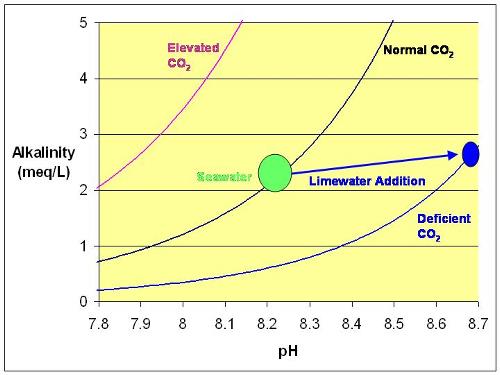
Figure 3. The effect of limewater addition on alkalinity and pH.​
In a previous article, I showed that adding sufficient hydroxide to increase the alkalinity by 0.5 meq/L (a 10 ppm calcium rise, if using limewater) immediately boosted pH from pH 8.10 to 8.76. After the system had a chance to recover by pulling in more carbon dioxide from the air, the pH subsided to 8.33.
Additives containing carbonate (such as many two part calcium and alkalinity additive systems) also deplete carbon dioxide by a similar process:
7. CO[FONT=Arial, Helvetica, sans-serif][SIZE=-1]3[/SIZE][/FONT]-- + H2CO[FONT=Arial, Helvetica, sans-serif][SIZE=-1]3[/SIZE][/FONT] ? 2HCO[FONT=Arial, Helvetica, sans-serif][SIZE=-1]3[/SIZE][/FONT]-
The effect of added carbonate on alkalinity and pH is shown in Figure 4. The effect of this on pH is smaller than the pH change caused by limewater, but these additive systems can still drive the pH excessively high if sufficient quantities are added to a marine aquarium.
Figure 4. The effect of carbonate addition on alkalinity and pH.​
In a previous article, I showed that adding sufficient carbonate to increase alkalinity by 0.5 meq/L resulted in an immediate pH rise from pH 8.10 to 8.44. After the system had a chance to recover by pulling in more carbon dioxide from the air, the pH subsided to 8.34, matching that produced by limewater and bicarbonate (after equivalent alkalinity additions followed by complete aeration).


Cheers
Pedro Nuno ;-)
 

Sponsor Reefs

We're a FREE website, and we exist because of hobbyists like YOU who help us run this community.

Click here to sponsor $10:


Top