Carbon Dioxide and pH
The pH of marine aquarium water is intimately tied to the amount of carbon dioxide dissolved in the water and to its alkalinity. In fact, if water is fully aerated (that is, it is in full equilibrium with normal air), then the pH is exactly determined by the carbonate alkalinity. The higher the alkalinity, the higher the pH. There is, in fact, a
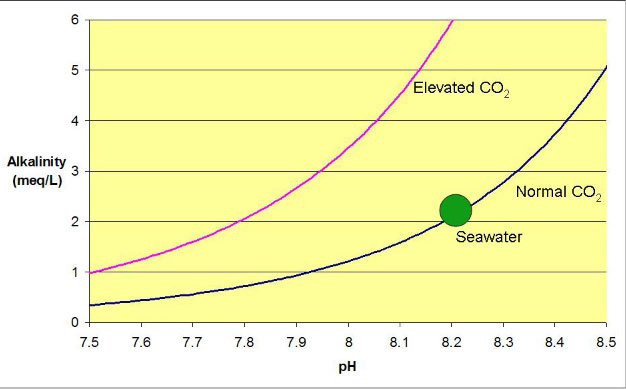
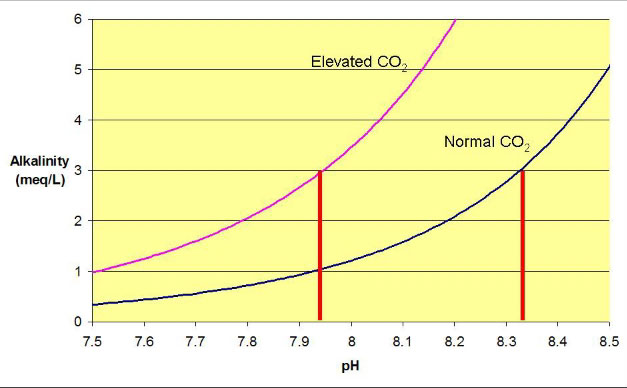
simple mathematical relationship between alkalinity, pH, and carbon dioxide that I have discussed previously. Figure 2 shows this relationship graphically for seawater equilibrated with normal air (350 ppm carbon dioxide), and equilibrated with air having extra carbon dioxide as might be present in certain homes (1000 ppm). Figure 2 also shows the pH/alkalinity relationship in water that is deficient in carbon dioxide.
Nearly all high pH situations encountered in reef aquaria are caused by a carbon dioxide deficiency.
Only rarely would excessively high pH be caused by high alkalinity alone, because in order for the pH to rise above pH 8.5 with a "normal" amount of carbon dioxide present, the alkalinity would have to be above 5 meq/L (Figure 2). At these high levels of both pH and alkalinity, calcium carbonate would very likely begin to precipitate abiotically, and such precipitation itself reduces pH and alkalinity. So if such a situation arose, it would not typically last long on its own in a reef aquarium.

Figure 2. The relationship between alkalinity and pH for seawater with normal carbon dioxide
levels (black), excess carbon dioxide (purple) or deficient carbon dioxide (blue). The green
area represents normal seawater.
Detailed Chemistry of CO[SIZE=-1]2[/SIZE] in Seawater
A simple way to think of the relationship between carbon dioxide and pH is as follows. Carbon dioxide in the air is present as CO[SIZE=-1]2[/SIZE]. When it dissolves into water, it becomes carbonic acid, H[SIZE=-1]2[/SIZE]CO[FONT=Arial, Helvetica, sans-serif][SIZE=-2]3[/SIZE][/FONT]:
1. CO2 + H2O ? H2CO[FONT=Arial, Helvetica, sans-serif][SIZE=-1]3[/SIZE][/FONT]
The amount of H[SIZE=-1]2[/SIZE]CO[FONT=Arial, Helvetica, sans-serif][SIZE=-2]3[/SIZE][/FONT] in the water (when fully aerated) is dependent not on pH, but only on the amount of carbon dioxide in the air (and somewhat on other factors, such as temperature and salinity). Systems not at equilibrium with the air around them, which includes many reef aquaria, may have too much or too little CO[SIZE=-1]2[/SIZE] in them, which is effectively defined by the amount of H[SIZE=-1]2[/SIZE]CO[FONT=Arial, Helvetica, sans-serif][SIZE=-2]3[/SIZE][/FONT] in the water. Consequently, if an aquarium is "deficient in CO[SIZE=-1]2[/SIZE]," that means that it has a deficiency of H[SIZE=-1]2[/SIZE]CO[FONT=Arial, Helvetica, sans-serif][SIZE=-2]3[/SIZE][/FONT]. This H[SIZE=-1]2[/SIZE]CO[FONT=Arial, Helvetica, sans-serif][SIZE=-2]3[/SIZE][/FONT] deficiency, in turn, means that pH will tend to be on the high side, and the more H[SIZE=-1]2[/SIZE]CO[FONT=Arial, Helvetica, sans-serif][SIZE=-2]3[/SIZE][/FONT] deficient it is, the higher the pH will be.
Seawater contains a mixture of carbonic acid, bicarbonate, and carbonate that are always in equilibrium with each other:
2. H2CO[FONT=Arial, Helvetica, sans-serif][SIZE=-1]3[/SIZE][/FONT]?? H+ + HCO[FONT=Arial, Helvetica, sans-serif][SIZE=-1]3[/SIZE][/FONT]- ?? 2H+ + CO[FONT=Arial, Helvetica, sans-serif][SIZE=-1]3[/SIZE][/FONT]--
Equation 2 demonstrates that when an aquarium has a deficiency of H[SIZE=-1]2[/SIZE]CO[FONT=Arial, Helvetica, sans-serif][SIZE=-2]3[/SIZE][/FONT], some of the HCO[FONT=Arial, Helvetica, sans-serif][SIZE=-2]3[/SIZE][/FONT][SIZE=-1]-[/SIZE] can combine with H[SIZE=-1]+[/SIZE], to form more H[SIZE=-1]2[/SIZE]CO[FONT=Arial, Helvetica, sans-serif][SIZE=-2]3[/SIZE][/FONT] (moving to the left in equation 2). Since H[SIZE=-1]+[/SIZE] is used up, the pH (which is simply a measure of H[SIZE=-1]+[/SIZE]) rises. If seawater has a big enough deficiency of CO[SIZE=-1]2[/SIZE], the pH can be as high as pH 9 or more.
Why Does pH Become Elevated?
As discussed above, a reef aquarium's pH rises when its water becomes deficient in carbon dioxide. In practice, this deficiency can be caused in several ways. The diurnal (daily) change in pH in reef aquaria occurs because of the biological processes of photosynthesis and respiration. Photosynthesis is the process whereby organisms convert carbon dioxide and water into carbohydrate and oxygen. The net reaction is:
3. 6CO2 + 6H2O + light ? C6H12O6 (carbohydrate) + 6O2
So there is net consumption of carbon dioxide during the day. This leads to many aquaria becoming deficient in CO[SIZE=-1]2[/SIZE] during the day, raising their pH.
Likewise, all organisms also carry out the process of respiration, which converts carbohydrate back into energy for other processes. In the net sense, it is the opposite of photosynthesis:
4. C6H12O6 (carbohydrate) + 6O2 ? 6CO2 + 6H2O + energy
This process is happening continuously in reef aquaria, and it tends to reduce the pH due to the carbon dioxide produced.
The net effect of these processes is that pH rises during the day and drops at night in most reef aquaria. This change varies from less than a tenth of a pH unit, to more than 0.5 pH units in typical aquaria. Complete aeration of the aquarium water will prevent the diurnal pH swing entirely, by driving out any excess carbon dioxide or absorbing excess carbon dioxide when deficient. In practice this goal is not often attained, and the pH does change between day and night.
Consequently, the pH will nearly always be highest at the end of the light cycle. The only time that this is not the case is when there are timed additions of other things that impact pH (e.g., limewater, other alkalinity additions, and even the entry of carbon dioxide from the room air, in which the level of carbon dioxide may vary as human activities around the aquarium change throughout the day). The diurnal pH swing alone is not typically strong enough to drive the pH of reef aquaria to excessive levels (i.e., pH > 8.5). If it does, the aeration is clearly inadequate, and more aeration will likely solve the problem.
The more common way for reef aquaria to attain excessive pH is through high pH additives, most notably the use of alkalinity additives that contain hydroxide (
limewater) or carbonate (some two part additives, for example). Figure 3 shows how the pH and alkalinity change as limewater is added to a reef aquarium. The
limewater converts some of the carbonic acid into bicarbonate, effectively making the water deficient in carbon dioxide (H[SIZE=-1]2[/SIZE]CO[FONT=Arial, Helvetica, sans-serif][SIZE=-2]3[/SIZE][/FONT]) until the aquarium can absorb more carbon dioxide from the air to replace the lost carbonic acid:
5. Ca(OH)2 ? Ca++ + 2OH-
6. OH- + H2CO[FONT=Arial, Helvetica, sans-serif][SIZE=-1]3[/SIZE][/FONT] ? HCO[FONT=Arial, Helvetica, sans-serif][SIZE=-1]3[/SIZE][/FONT]-
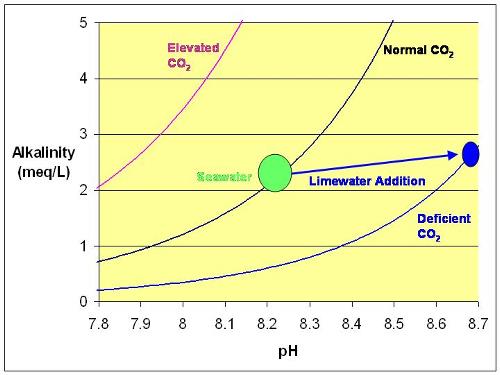
Figure 3. The effect of limewater addition on alkalinity and pH.
In a
previous article, I showed that adding sufficient hydroxide to increase the alkalinity by 0.5 meq/L (a 10 ppm calcium rise, if using limewater) immediately boosted pH from pH 8.10 to 8.76. After the system had a chance to recover by pulling in more carbon dioxide from the air, the pH subsided to 8.33.
Additives containing carbonate (such as many
two part calcium and alkalinity additive systems) also deplete carbon dioxide by a similar process:
7. CO[FONT=Arial, Helvetica, sans-serif][SIZE=-1]3[/SIZE][/FONT]-- + H2CO[FONT=Arial, Helvetica, sans-serif][SIZE=-1]3[/SIZE][/FONT] ? 2HCO[FONT=Arial, Helvetica, sans-serif][SIZE=-1]3[/SIZE][/FONT]-
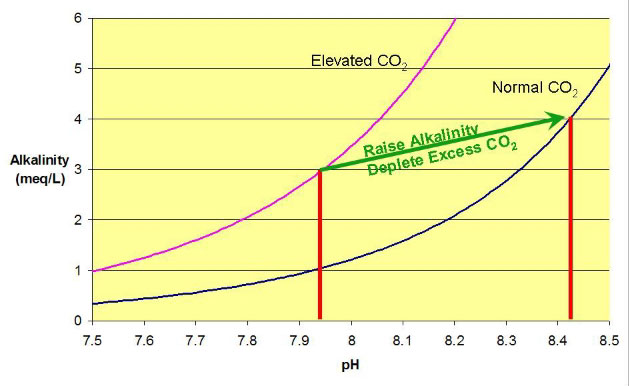
The effect of added carbonate on alkalinity and pH is shown in Figure 4. The effect of this on pH is smaller than the pH change caused by limewater, but these additive systems can still drive the pH excessively high if sufficient quantities are added to a marine aquarium.

Figure 4. The effect of carbonate addition on alkalinity and pH.
In a
previous article, I showed that adding sufficient carbonate to increase alkalinity by 0.5 meq/L resulted in an immediate pH rise from pH 8.10 to 8.44. After the system had a chance to recover by pulling in more carbon dioxide from the air, the pH subsided to 8.34, matching that produced by limewater and bicarbonate (after equivalent alkalinity additions followed by complete aeration).