


• Why not take a moment to introduce yourself to our members?

Capslock

Experienced Reefer
Rating - 0%
0   0   0
Hello,

So my tank is pretty much ready, the RO water with mixed in salt is in the tank and is reading 1.023 in salinity. At this point the only thing I need to do is add water to the sump and then turn everything on.

What I am planning is filling it all up empty and then turn all my equipment on to be sure the temp control and pump work before buying any live rock.
I will end up having to take a lot of water out to put live rock in but hey, this is what I am willing to do to make sure all systems are go.

Anyways, final questions before this weekend.
Since the salinity is at 1.023, assuming i keep it at that level when adding the final batch of water, does this mean I am ready to add my live sand / live rock?

Live rock/sand helps filtration so other levels like ph etc. does not necessarily matter at this point? Other than live rock/sand i have no intentions of adding any other living thing in there until much later when everything is right.

There are a ton of small bubbles sticking on my tanks glass; this I assume is ok when adding live rock / sand?
It will go away once the pump starts flowing water through the system or will I need to take my hand and brush it out?

Ideally I am looking to turning the pump on tonight, so maybe I should put the sand in before work so it can settle.

Thoughts?

 
A

Anonymous

Guest
Rating - 0%
0   0   0
I would put the sand in asap and then turn everything on, when you are going to home for a few hours. The water must be circulating to get oxygen throughout. It will take a few hrs/days to get the temp just right, adjusting up and down.

Once the pumps are circulating and the temp is good, you can add the live rock.

pH does not neccessarily matter at this point. Not that it doesn't matter, just that you can't really change it much anyway at this point!

The bubbles will go away, but you can hurry it up with a mag float.

Turn everything on, put the sand in, and watch the cloudy water move now. Then you will be able to see the water motion through out the tank. Don't worry if you think it is not right. That is part of the obsession!

I think a build thread would be cool?
 

Capslock

Experienced Reefer
Rating - 0%
0   0   0
Excellent to hear, I walk to work so I can just run back to put the sand in so I can start the pumps when I get home.

A Build thread I would imagine is a picture history of the setup.

I took initial shots of the tank empty, I didnt take any while filling the water up (didn't seem necessary to log that). Ill start one of them up sometime tomorrow I would imagine.


The last question I have, probably the most important.

Can you give me some tips on logistics of starting the pump?
Do I start the siphon first for the overflow or start the pump first? I think this is an obvious answer (start the siphon first) but I want to confirm this so I dont end up in a catastrophe in 10 seconds.
 
A

Anonymous

Guest
Rating - 0%
0   0   0
I start my pump first, then as the water reaches the over flow, it starts the flow into the sump.

Do you have an overflow box?

It is very important to have the siphon going at all times because the pump could potentially overflow the tank if it doesn't flow into the sump.

Imagine it like this: The power goes out, and the tank drains into the sump. The power comes back on and the pump restarts. It has to be able to do that with no intervention from you in case it happens when you are not home.

So, when you get it started tonight, unplug the pump and see what happens. You will find that when it is working correctly, the sump can handle the extra water from the tank and the tank can only drain so much until the overflow stops draining....

Is the main display drilled or do you have an outside or inside oveflow box?
 

Capslock

Experienced Reefer
Rating - 0%
0   0   0
Oh man, that is a good point; ive been thinking about all these possibilities but you touched on one I have missed.

I have an overflow box, nothing it drilled. I can try to draw a couple pictures to illustrate if you need it but you know what an overflow box is.

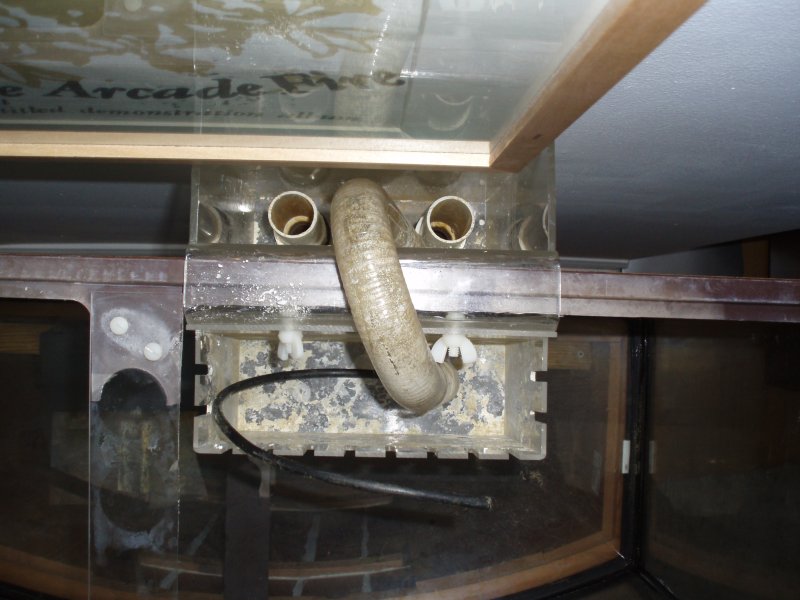
I have the box in the tank itself, there is then a U shaped tube that goes up from the box in the tank and around to the box behind the tank where two 1/2" drain pipes are located. The U shape tube is free to move if I so wish, it is just sitting there doing its duty.

Anyways, so if the pump failed, I understand that the water would drain into the sump and currently it would stop at the level the overflow box stops draining; but wouldn't that lose the overflow boxes siphon? Then what happens if the pump is turned on? The tank would overflow.....this is indeed a serious issue.
 
A

Anonymous

Guest
Rating - 0%
0   0   0
If the overflow is made correctly, it shouldn't. It should drain the part where the siphon isn't, while the siphon tube stays under water in it's part. Can you get a pic of it?

Chris, can you explain this better than I?
 

Capslock

Experienced Reefer
Rating - 0%
0   0   0
Yeah I am a bit lost on this.

Ill post a pic of course. Ill be walking home for lunch to add the sand. I will take a picture real quick and send it out.
 

ChrisRD

Advanced Reefer
Location
Upstate NY
Rating - 0%
0   0   0
As Suzy mentioned - if the overflow is made correctly it should restart. Do you know which manufacturer/model you have? Some of these hang-on types are not so reliable (I prefer to drill my tanks). BTW, two 1/2" outlet pipes sounds weird to me and won't have much capacity.

Also, we typically shoot for an SG of 1.025 to 1.026 in a reef setup (seawater conditions). You might want to bump that up a bit.

As for adding sand - it doesn't have to happen right away, and in fact, I prefer to hold off (actually I often don't add it at all :wink: ). Typically new rock sheds some crud for a while and I prefer to leave the tank bare for this initial period to facilitate syphoning this stuff out rather than have it get into the sandbed. Of course, this is just my preference...
 

Capslock

Experienced Reefer
Rating - 0%
0   0   0
Thanks for the input.

The manufacturer of the overflow seems to be made from the prior owner.

No big deal, but it is def. a custom setup.


Chris, I have seen you making that comment before; it has been in the back of my mind. I imagine myself putting live rock in the sump first, then when it is ready move it up to the display tank. Does it make sense to do it this way?

Here are some pictures for your viewing pleasures. It is what I had (it took to long to walk home and back to take pictures then convert them to the proper size). If you need other angles i can take shots when i get back home.

Thank you for the salinity tip. I read it was suppose to be 1.021 to 1.025; I will review and make the adjustments necessary.
 

Attachments

  • overflow.jpg
    overflow.jpg
    71.1 KB · Views: 1,840
  • overflowTop.jpg
    overflowTop.jpg
    59.1 KB · Views: 1,842
A

Anonymous

Guest
Rating - 0%
0   0   0
That should restart. See how the water level on both sides will remain the same when the water quits coming in and going out? One thing that will happen is tiny bubbles will get into the lift tube and need to be sucked out occasionally. I would get another lift tube to be a bit safer.

I will like drilled tanks, too. You might think about drilling it now before the tank is going strong.
 

Capslock

Experienced Reefer
Rating - 0%
0   0   0
Ok, thanks for the support. I still do not really understand the physics as to why it would restart by itself, but I am sure it will be clear when i make my own tests.

It sounds like it would be a better idea to have a second lift just as you said as a backup; I like backups (two lines in the drain instead of one, two heaters; should have bought two pumps, oh well)

Anyways,
drilled holes was an idea I toyed with however since I am just starting out with this hobby I think it would be best to take that step later in life, particularly if I get a new tank down the road.
 

ChrisRD

Advanced Reefer
Location
Upstate NY
Rating - 0%
0   0   0
Capslock":1d54vtqm said:
I imagine myself putting live rock in the sump first, then when it is ready move it up to the display tank. Does it make sense to do it this way?
Sounds fine if the sump is big enough.

Capslock":1d54vtqm said:
Thank you for the salinity tip. I read it was suppose to be 1.021 to 1.025; I will review and make the adjustments necessary.
That range is fine is fine for fish, but with reef tanks most of us target natural seawater (NSW) conditions. SG of NSW @ 77 degrees F is commonly accepted as 1.0264.

A side shot would be helpful, but that overflow looks like it should work. Personally I'd sleep much better at night with a drilled tank. Try to setup your sump so there's not enough water available to the return pump to overtop the main tank if the syphon fails.
 

Capslock

Experienced Reefer
Rating - 0%
0   0   0
77 degrees - understood, i was shooting at 75.

Ill take a side shot just for the record, i am feeling pretty comfortable about this now.

i THINK i will be able to setup the sump the way you described.
What I am imagining is that if the siphon fails, the baffles would prevent more water from being pushed to the pump; so essentially what I need to do is figure out how much water I can allow on the pump side; is this correct?

Also; if the siphon did fail at some point, how hard would this impact the pump lifespan?
 

ChrisRD

Advanced Reefer
Location
Upstate NY
Rating - 0%
0   0   0
The temp I gave is just the reference temp that NSW density is given for (density changes as temp changes), although 77 is fine for a reef tank as well IMO. Anything from mid 70s to low 80s should be fine - I prefer upper 70s.

Yes, the divider position in the sump will determine how much water the pump can push before it runs dry. It won't actually run completely dry - it will lose prime and just sorta gurgle. As for how much of this a pump can take - thankfully I've never had to find out. :wink:
 

Mthompson

Experienced Reefer
Rating - 0%
0   0   0
It depends on what type of pump you have. Many of the magnetically driven pumps can run dry with minimal damage, just not continuously as they can overheat.

Another problem when a pump is 'gurgling', it can actually cause gas super-saturation. This happens when pressure forces more gas into solution than would normally be possible. This condition is very very dangerous to the tank inhabitants. Luckily this is rare, as most of us use lower powered pumps that cannot build a lot of pressure.

For your overflows, they look like they will work. The two pipes in the rear portion will keep water at that level, which will also be the same level in the front portion. The overflow tube will be below the water level in the back and front, preserving a static siphon (not flowing). When water begins flowing again, it will fill up the front portion, thus causing pressure that forces water through the overflow and into the back portion.

I was confused about all this overflow stuff when I got mine in. I ended up playing around with them in the sink. Just fill up both sides as much as they can hold. Suck the air out of the u-tube and then watch the two portions equalize. Then with a cup, dump some water in the front portion (with the slits) and watch what happens. Once you see it work, it will make perfect sense.

Hope this helps.
 

Capslock

Experienced Reefer
Rating - 0%
0   0   0
Ok ive been running it throughout the day and I have a good understanding now.

Unfortunatley I seem to have forgotten basic physics i.e. gravity before I started the siphon. What is happening is well...

Ok so I have the overflow and the pump; I am thinking I should get a smaller pump, I see why the larger pump doesnt make sense there wasnt enough water going through the single life support the pump.

So I added a few temporary solutions i.e. 4 additional vinyl 3/4" lifts. This should have been plenty but I wasnt able to get enough flow until I got that 4th vinyl lift in the overflow in order for the pump to not suck in air.

The most problematic right now is the noise level; it isnt the pump that is making the noise thats a problem, its the drains in the overflow box. Its sucking in air.

It makes sense with gravity (i guess I was expected that there would be more water in the overflow (where the drains are) but it sucks it all in.

What have you guys done to combat this? At the current moment there is no way I can operate this tank with the noise from the drains sucking air in...i can barely hear myself speak (its not that bad but, it is)
 
A

Anonymous

Guest
Rating - 0%
0   0   0
Hmm, I am not sure I understand. If it is because the drains are draining too fast, you can get a ball valve for the drains from Home Depot. Then, you can adjust it to hold back a bit, so it drains a bit slower. Sometimes, having a drain filled with water can decrease the noise...

Even a T at the end of the drain will slow it enough to alleviate the noise.

Other guys: Would a durso drain help here?
 

Mthompson

Experienced Reefer
Rating - 0%
0   0   0
If the drain is pulling enough water through the pipe, it can sometime create a vacuum that will create a suction noise every few second when the vacuum is broken. To fix this you can insert a short length of airline tubing which will prevent the vacuum from forming.

The other, more common, case is that the water falling in the drain tube just makes noise because of the friction with the tube. To alleviate this you can make an acrylic cover that goes over the top of the back portion of the overflow. You can test how much this would help your situation by cutting some cardboard and placing it on the overflow temporarily. This cardboard can then serve as a good template for cutting the acrylic... :wink: :wink:
 

Capslock

Experienced Reefer
Rating - 0%
0   0   0
It is definitely creating a vacuum. I have a small 1/4" air tube that I used to start the siphons, I put that into the drains but no luck silencing the vacume.

I could try the ball valve but I am wondering what that would do in terms of the pump; it requires a lot of rushed water.....hmmmm...I believe I will need to check this out further
 

Capslock

Experienced Reefer
Rating - 0%
0   0   0
UPDATE:
I discovered a quick and dirty way to fix the noise from the drains.

I have a bunch of 3/4" vinyl tubing left over from setting up the return line.
I simply cut 2, 1" long pieces, and then cut one side of it so I could bend it a little but not so much that the pieces would fall into the drains.

One of them I laid directly on top of the right drain (the one making the most noise) and the second piece I leaned upward on the left drain forcing the water to rise just enough to stop the right from hissing (in addition to the blockage) but still allowing all the water through. The vinyl on the left drain in effect took the space where the air vacuum would have been.

Now I am questioning myself on the reliability of this. The noise stopped but the water raised a bit in the sump where the pump is (which turned out to be better anyways). I just hope this doesn't end up causing problems with water flow - it doesn't seem to effect anything now but time will tell.


EDIT: Actually, I do not think the raised water level on the pump side of the sump was due to this action. Today I bought 3 pieces of live rock and also two of those things you attach to the return lines, they are like a U shape only 2 90 degree turns instead and at the end the line turns another 90 degress and then goes from an O shape tube to a flatter shape. I am pretty sure these two pieces alone added substantial length to the return lines pressure and is what is causing the water to build up a bit, again, this is fine for now.


I also bought 3 pieces of live rock today, they are in the sump now adjusting to their new home.
 

Sponsor Reefs

We're a FREE website, and we exist because of hobbyists like YOU who help us run this community.

Click here to sponsor $10:


Top